


About one in ten people are left-handed, but in club tennis and pickleball it can feel like the only lefties you ever play are the ones who beat you. There is a reason. Lefties spin the ball the opposite direction, attack different parts of your body, and break the patterns that work against the other 90 percent of opponents you face.
The good news is that lefties have predictable strengths and predictable weaknesses, just like everyone else. The bad news is that you have to actually adjust your game to find them. Standing on court playing your normal patterns will not work, because your normal patterns are tuned for righties.
This post covers what changes when you face a lefty in tennis and in pickleball, the specific patterns that tend to work, and how to use match data to figure out which adjustments are paying off.
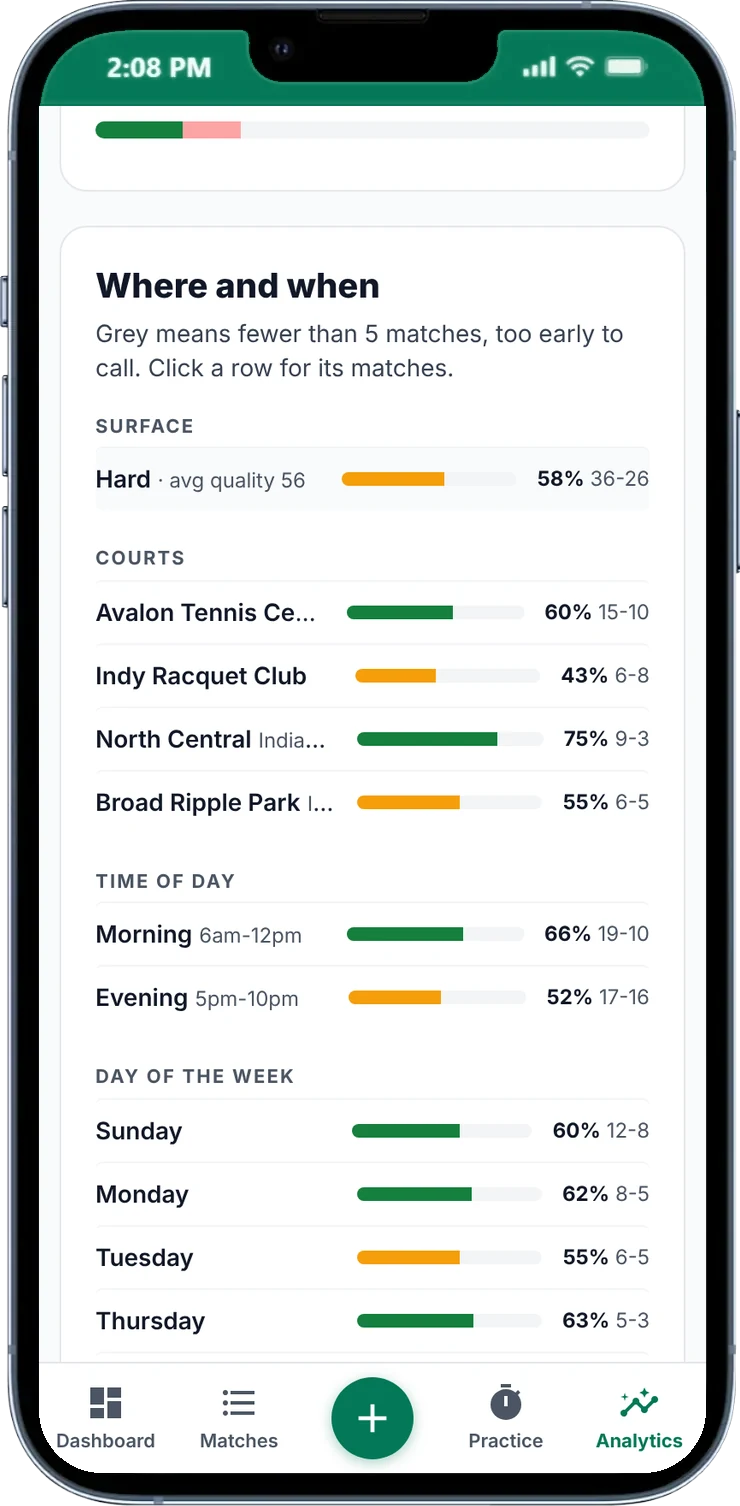
Track the handedness of every opponent you face. Once you have a sample, you can compare your win rate against right-handers versus left-handers and see exactly where the gap is. RecAce stores opponent handedness on every record, so the data builds itself over time.
What Actually Changes When Your Opponent Is a Lefty
The mechanics are simple but the consequences are wide. A right-handed forehand spins the ball away from a right-handed opponent's forehand. A left-handed forehand spins the ball away from a right-handed opponent's backhand. Every cross-court rally, which is the default pattern for almost every recreational point, runs in the opposite direction.
Specifically, against a lefty:
- Their forehand cross-court goes to your backhand. Your default cross-court rally exposes your weaker side instead of locking up theirs.
- Their slice and kick serves break the other way. A righty kick serve to the ad court bounces toward your forehand. A lefty kick serve to the ad court bounces away into your backhand corner.
- Their preferred sidelines flip. A righty hits their best down-the-line shot from the deuce side onto your forehand. A lefty does the same shot from the ad side onto your backhand.
- In doubles, their strong forehand sits on the opposite side of the court. A righty paired with a righty has both forehands in the middle. A righty paired with a lefty has both forehands on the outside (or, with stacking, both in the middle, which we cover below).
If you have ever finished a match against a lefty thinking "every ball seemed to find my backhand," that is not your imagination. That is geometry.
Tennis: How to Adjust Your Singles Game
The single biggest adjustment is on the serve. Specifically, how you direct your serves on big points.
Most recreational players have a default "go-to" serve location they reach for on pressure points: usually their best slice serve into the deuce court (a righty's most reliable wide serve). Against a lefty, that serve hits their forehand. They love it.
The pressure-point serve against a lefty needs to flip. Slice serves wide on the ad side go to their backhand. Body serves jam them on either side. Down the T from the deuce court runs into their backhand. The patterns that worked on autopilot against righties need to be deliberately reversed.
In rallies, two adjustments matter most:
Hit your forehand to their backhand. Cross-court groundstrokes from the deuce side now go to their backhand instead of their forehand. This is the lefty version of the rally pattern that has been winning matches for righties forever.
Aim returns down the line. A return cross-court off a lefty serve goes back to their forehand. A return down the line goes to their backhand and forces them to set up on their weaker wing.
These changes take real focus because they are the opposite of muscle memory. The first set against a lefty often feels off because you are still hitting your default targets. The second set tends to be tighter because you have caught up. If you log enough matches, you will see this pattern in your set-by-set scores.
For a deeper look at finding patterns inside your match history, our breakdown of analyzing your tennis game without a coach covers how to spot trends like this in your own data.
Tennis Doubles: The Ad-Side Lefty Problem
In tennis doubles, lefties traditionally play the ad court. The reason: their forehand covers the middle on the most common deuce-side cross-court rally, AND their forehand serve out wide on big points (which in doubles are usually played on the ad side, like 30-40 or break point) goes to the returner's backhand.
If you face a righty-lefty pair with the lefty on the ad side, the math is brutal. Both their forehands cover the middle, both their best serves attack your backhand on big points, and they have natural angles you do not.
Three counter-tactics tend to work:
- Serve and return into their backhands more aggressively. This means body serves and slice serves into the lefty's left-side body, plus down-the-line returns from the deuce court that find the righty's backhand instead of running cross-court into the lefty's forehand.
- Lob over the lefty when they are at the net. Their overhead is on the same side as a righty's overhead, but the geometry of where they receive the lob is different. Many lefties are slightly less comfortable with overheads from the deuce side because they get fewer reps there.
- Force them to switch sides. If you can run them out of position with deep middle balls, they spend the next few seconds reorganizing rather than attacking.
For a wider treatment of doubles formations and side selection, the post on singles vs doubles tracking covers why the format matters more than most players realize, and our data-driven doubles partnership stats post shows how partner pairings shape your win rate.
Pickleball: The Lefty Targeting Game
Pickleball points are short, the court is small, and most rallies live within the kitchen and a few feet behind it. The lefty effect is concentrated, which makes it easier to plan for and easier to exploit.
The two patterns that change most:
Third-shot drops and drives. A righty's cross-court drop from the deuce side goes to a righty opponent's forehand corner of the kitchen. The same drop against a lefty goes to their backhand corner. Many recreational lefties have a noticeably weaker backhand drop volley because they get fewer reps off that side. Targeting it is high-percentage.
Dink rallies. A long cross-court dink from the deuce side runs into a lefty's backhand. Most kitchen exchanges end when one player gets attacked off the bounce. Forcing those exchanges onto a lefty's backhand wing tilts the math toward the side that is targeting them.
The biggest adjustment most pickleball players need to make: do not default to attacking the middle. Against a righty-lefty pair, the middle is where both forehands meet. Anything attackable in the middle gets put away. Against a lefty alone, attacks should bias toward their backhand sideline, not the body.
Doubles Stacking Against a Righty-Lefty Team
Pickleball doubles teams use stacking specifically to keep both forehands in the middle. A right-handed and left-handed pair can do this without any movement: the lefty plays the deuce side, the righty plays the ad side, and both forehands cover the dangerous middle ball.
If you face this pairing, stacking against them lets you do the same. Two righties can stack so that the stronger forehand handles the middle, neutralizing the lefty pair's natural advantage. We cover the mechanics and when it pays off in pickleball stacking explained.
The shorter version: if you play a righty-lefty pair more than once, stacking is usually the right answer. The cost is communication overhead. The benefit is putting both your forehands where their forehands live.
Tracking Whether Your Adjustments Work
This is where match data earns its keep. Most players who lose to lefties do not actually know how big the gap is. A vague feeling of "I always lose to lefties" is hard to act on. A specific number ("my win rate against righties is 62%, against lefties is 41%") is something you can work with.
The simple version of the test:
- Log opponent handedness for every match. RecAce stores this on the opponent record so once you tag a player you know once, the data follows them.
- After 30 to 50 matches, pull up your win rate split by opponent handedness. A 10-point gap or larger is a real pattern. Smaller than that is probably noise.
- Add a one-line note to lefty matches about what worked and what did not. Over a season, the patterns surface. "Slice serve wide ad side worked" appearing in three winning matches and absent in two losing ones is a clear signal.
The note field is the hidden value here. The structured stats (handedness, score, surface) tell you what happened. The notes tell you why.
A Pre-Match Plan for Your Next Lefty
Before the match:
- Pull up any prior matches against this opponent. If your match log has them, look at the score lines and any notes from past meetings. Our opponent scouting guide covers what to capture.
- If you have never played them, look at your overall record against lefties. If it is below your overall win rate, plan for the geometry adjustments above. If it is at or above, your existing patterns probably hold up.
In the warmup:
- Watch their forehand and backhand for a full minute. The asymmetry will tell you which side is stronger. A lefty with a strong forehand and an exposed backhand is the most common pattern, but it is not universal.
- Hit a few balls deliberately to their backhand and see how they handle them. If they slice everything back without taking any heat off, the rally pattern that wins is feeding the slice and attacking the short reply.
Early in the match:
- Use the first three or four games as data collection. Direct serves both directions, hit groundstrokes both directions, and notice what comes back.
- By the second changeover, the patterns are usually clear. Commit to them.
After the match:
- Log it. Note the handedness, the score, what worked, and what did not. The next time you see a lefty, you start with a prior. The match after that, the prior is sharper. Over a season, your lefty win rate tends to climb because you are no longer playing them blind.
The Pattern Beats the Stereotype
There is a stereotype that lefties win because they are awkward. Awkward is not a strategy. The reason a lefty might beat you the first time you play them is that you are running your default patterns into their strengths. The reason a lefty might beat you the third time is that you have not actually adjusted.
Players who track their matches close the gap faster because they can see the gap. Players who do not track tend to chalk losses up to "lefties are just weird" and lose the same way next time. The data is the difference.
Log your matches free at RecAce and tag opponent handedness. After your next 20 or 30 matches, the lefty question stops being a feeling and starts being a number you can do something about.