


You watch a 4.5 doubles match and notice something odd. Both players on the same team line up on the right side before a serve, then one of them sprints across the court the moment the ball is struck. Or two teammates simply swap halves between points without any obvious reason. That is stacking, and it is one of the most underused tools in recreational pickleball.
Stacking is a positioning strategy, not a rule violation. It lets a doubles team keep their stronger forehand or their better player in their preferred half of the court regardless of which partner is serving or returning. Done well, it raises the team's win rate without requiring either player to improve a single shot.
This post covers what stacking actually is, when it pays off, when it does not, and how to use match data to test whether it is helping your team.
Track every doubles match you play, including which side you played and who your partner was. Once you have a sample of 20 to 30 matches, you can compare your win rate stacked versus unstacked and see whether the strategy is earning its keep. RecAce keeps your partner on every doubles match and has partner-level statistics; add a word about the side you played in the match notes.
What Stacking Actually Is
In standard pickleball doubles, the server starts on the right side when the team's score is even and on the left when it is odd. After each point won on serve, the server switches sides with their partner. Over a long game, both players spend time on both sides.
Stacking changes that pattern. Both players start the point on the same side of the court before the serve or return, then one of them moves across to the position they want to play from. There are two main flavors:
Stacking on the serve. Both players line up on the same side before the serve. The server hits from the correct service box, then immediately moves across to the side they prefer. The non-serving partner moves the opposite way at the same moment.
Stacking on the return. The returner stands in the legal return box, but their partner stands close to the sideline behind the returner instead of the kitchen line on the opposite side. After the return is struck, both players shift to their preferred halves before the third shot.
The end state is the same in both cases: the team plays the rest of the point with each partner on their preferred side, regardless of what the score dictates.
Why Teams Stack in the First Place
The single biggest reason teams stack is to keep both forehands in the middle of the court. In a right-handed and left-handed pairing, this is automatic if the right-hander plays the deuce side and the left-hander plays the ad side. Both forehands cover the middle, which is the most contested zone in a doubles point.
For two right-handers, stacking is what makes the same pattern possible. If one player has a much stronger forehand or a better poach, putting them on the ad side (and stacking to keep them there) pulls more of the middle balls onto their racket.
Other common reasons:
- Skill imbalance. A 4.0 player paired with a 3.5 partner may stack to keep the stronger player at the kitchen line as much as possible, with the weaker player serving and immediately retreating across the court to a less exposed position.
- Body coverage. Some players are simply much faster moving in one direction than the other. Stacking lets them play their strongest movement pattern point after point.
- Specific opponent matchup. If the opposing team has a habit of attacking down a particular line, stacking lets you put your strongest defender on that side every point.
For more on how partner combinations shape outcomes, see our breakdown of pickleball doubles partner stats.
When Stacking Is Worth It
Stacking adds a small amount of complexity to every point. That cost is real, especially under fatigue or in long matches. The benefit needs to be larger than the cost for the strategy to pay off. Here are the situations where it usually does.
Lefty-Righty Pairings
This is the cleanest case. Without stacking, a lefty-righty pair has both backhands in the middle half the time. With stacking, both forehands are in the middle every point. The strategy almost always pays off here, and the only question is which version (serve stack, return stack, or both) fits the team best.
Big Skill Gap
When one partner is meaningfully stronger, stacking lets the team route more touches through that player. The weaker partner takes fewer high-pressure balls, and the stronger partner gets more reps in the middle. Over a full match, this typically tilts the win probability noticeably in the team's favor, especially against opponents who have not adjusted to the formation.
Specific Tactical Goals
If a team has decided that one player is the designated poacher, stacking lets them set up the poach side consistently. If a team wants to protect a player who is recovering from an injury, stacking keeps them out of the most exposed half of the court. The strategy is most effective when it is built around an explicit decision, not just a vague preference.
When Stacking Is Not Worth It
Stacking has costs, and ignoring them is how teams end up with a worse record after switching strategies. The most common downsides:
Communication overhead. Every point requires both players to remember the formation, hand-signal it, and execute the movement cleanly. In a long match against a tough opponent, mistakes here cost free points.
Predictability. Once an opposing team notices the stacking pattern, they can serve or return into the gap created by the cross-court movement. A serve to the alley behind a stacking partner who is already mid-cross can win the point outright before the returning team is set.
Physical cost. A server who stacks and crosses on every serve covers significantly more ground per game. By the second hour of a tournament day, that fatigue compounds.
Skill mismatch in reverse. Sometimes the partner who is "weaker" is actually playing well that day. A stacking pattern that hides them takes their best shots out of the rotation.
If you log match competitiveness data and see your win rate drop on long match days when you stack, fatigue is probably the culprit.
How to Test Whether Stacking Helps Your Team
This is where match tracking earns its keep. Stacking is a textbook strategy choice, the kind you can A/B test if you log your matches consistently.
The simple version of the test:
- Pick a partner you play with at least once a week. Consistency matters more than match count.
- Track every doubles match for two months. Note the partner, the format, the opponents, and the result. Add a one-line note about whether you stacked.
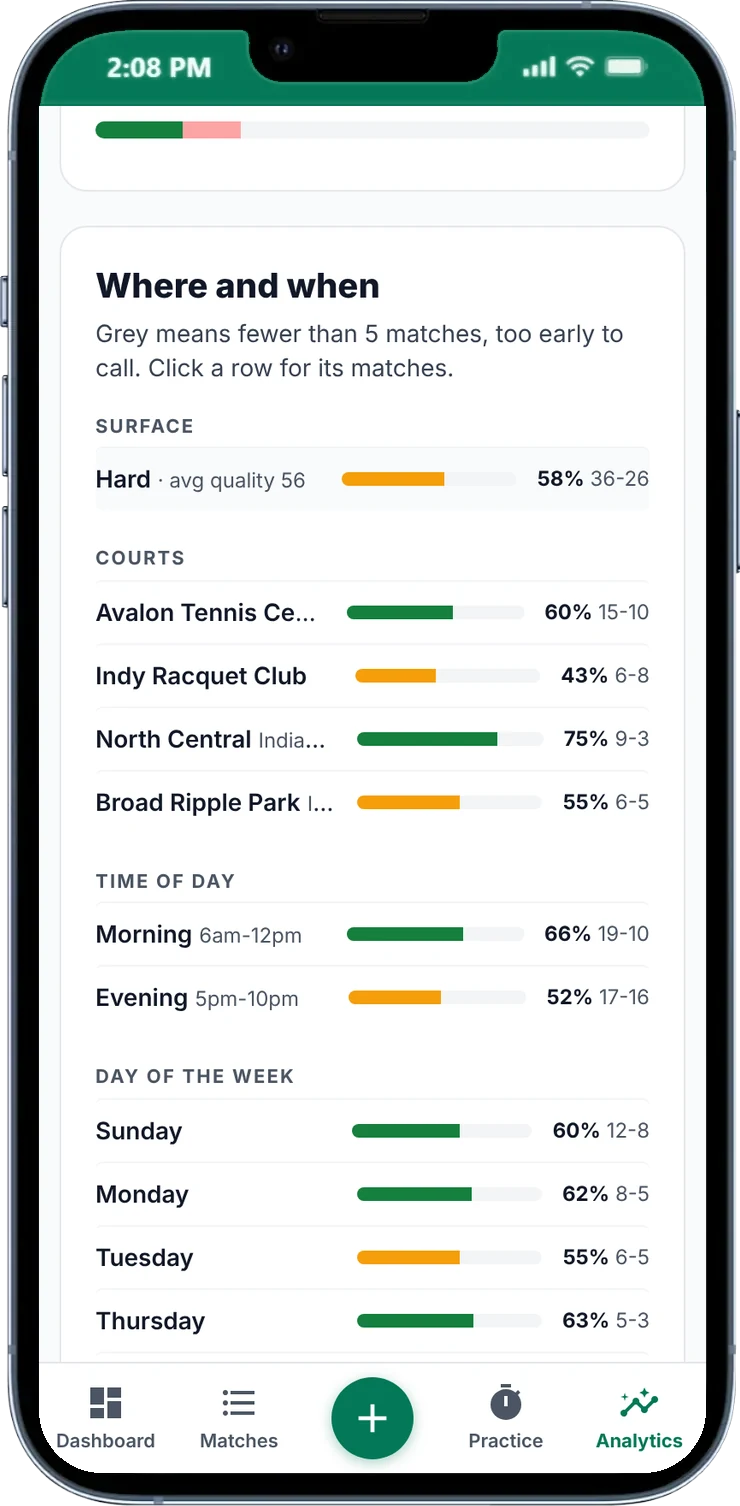
- At the end of two months, pull up your win rate stacked versus unstacked. In RecAce, search your matches for "stacked" (the search reads your notes) and compare that record with your other doubles matches with the same partner.
- Look at the gap. A 5 to 10 percentage point swing one direction is meaningful. Less than that, and the formation is probably not the deciding factor.
Be honest about confounders. If you only stacked against your hardest opponents, your stacked win rate will look worse than it should. The note field in RecAce lets you flag those cases so you can find them later with search.
Stacking Notation: What All Those Letters and Numbers Mean
If you read instructional content or watch broadcast pickleball, you will see formations described with shorthand. The basics:
- Even / Odd. Refers to the team's score, which determines where the server stands.
- Stacked Right / Stacked Left. The side both players line up on before the serve or return.
- Switch. The crossing movement that happens after the ball is struck.
In casual play you do not need any of this. You just need a quick gesture or word with your partner before the point. "Stack right" between the two of you can mean whatever you have agreed it means. Keep the language simple and consistent so you do not lose points to confusion.
Doubles Stacking and Singles Skills Are Different
A 4.0 singles player is not automatically a 4.0 doubles player. The stacking decision is one of the reasons. Doubles success depends heavily on positional discipline and partner communication, two things that a strong singles game does not develop.
This is exactly why we recommend tracking singles and doubles separately. Your singles and doubles ratings will diverge over time, and the gap usually points at exactly the kind of tactical decision (like stacking) that doubles rewards and singles ignores.
A Simple Plan to Try Stacking This Season
If you have never stacked, here is the lowest-friction way to test it.
Week 1. Pick one regular partner and one familiar formation (lefty-righty if you have it; otherwise a serve stack with both partners on the ad side). Use it in every doubles match you play. Do not switch back midway through. Log every match.
Week 2. Same partner, same formation. The goal is to make the movement feel automatic.
Week 3. Add the return stack. By now you should know whether the serve stack alone moved your win rate.
Week 4. Compare the four-week sample against your prior unstacked record with the same partner. The number will not lie.
If your win rate is higher and your matches feel cleaner, you have a permanent addition to your doubles game. If it is flat or lower, you have ruled out a strategy and saved yourself months of arguing about it. Either result is useful.
For broader context on how match data shapes doubles partnership decisions, and on how the best teams build a competitive community that produces enough match volume to test strategies like this, those guides go deeper.
Stacking Is a Strategy, Not a Style
Recreational players often treat stacking as something only advanced teams do. It is not. It is a tool, and like any tool, it works in some hands and on some materials and not others.
The only honest way to know whether it works for your team is to test it with real matches and real data. Log your doubles results in RecAce, include who your partner was and which side you played, and after a month or two, the answer will be sitting in your dashboard. Most teams that try stacking with a willing partner end up keeping it, at least in some matchups. The ones who try it and drop it usually do so for reasons (fatigue, communication mismatch) that the data made obvious.
Either way, you will be making a decision based on results instead of guesswork. That is the entire point.