


If you have a junior in tournament tennis, you already know the routine: a Saturday draw, two or three matches, a long drive home, and a kid who remembers the last point of the last match and almost nothing else. By the next tournament the details are gone. Who beat them in the round of 16 in March? What was the score? Was it the lefty?
Most parents keep this in their head, a notes app, or a spreadsheet that stops getting updated in May. A simple match log fixes it, and it pays off in ways you don't see until a season or two in.
Why a Match Log Matters More for Juniors
Adult rec players track matches out of curiosity. For a junior, the record does real work.
It settles arguments with facts. "I always lose to her" might be 1-4, or it might be 3-3 with the last loss still stinging. Kids remember losses louder than wins, and a record they can scroll through calms that down.
It shows progress that ratings hide. A UTR can sit still for months while your player goes from losing 6-1, 6-1 to the same opponent to losing 7-5 in a third-set tiebreak. The rating barely moves. The scores tell you they're closing the gap.
It gives the coach something to work with. "We lost in the second round" is not much to go on. "Lost 6-4, 6-3 to a lefty who served wide on the ad side all match, third loss to a lefty this year" is a lesson plan.
And it builds the record college coaches ask about. When recruiting starts, coaches look at UTR first, then at results: who your player has beaten, at what level, and whether the trend points up.
What to Log After Each Match
Keep it short enough that you'll actually do it in the car. The essentials:
- Opponent's full name, spelled the same way every time. A head-to-head record only works if "Sam Lee" and "Samuel Lee" are the same person.
- The score, set by set, including tiebreaks and match tiebreaks
- Date and event: "Midwest L5, Round of 16" is plenty
- The opponent's UTR (or NTRP) on the day, if you can see it in the draw
Then the details that turn a list of scores into something useful:
- Surface and indoor or outdoor
- Singles or doubles, and the doubles partner
- The opponent's hand
- One or two lines of notes: what worked, what didn't, what the opponent did. Write it with your player if they're willing. "Their own words" notes are the ones they reread.
Five minutes after a match, all of this is fresh. Three days later, half of it is gone.
Tracking Ratings: Your Player's and Everyone Else's
Junior tennis runs on UTR. If you're not sure how it works or what a given number means, start with what a good UTR is at each level, and if your player also plays USTA adult leagues or you're comparing scales, the UTR to NTRP chart covers both.
The part most parents miss is the other side of the net. Recording each opponent's UTR when you play them tells you, a year later, whether a win was an upset or expected. A 6-3, 6-4 win over a 7.5 means more when your player was a 6.8 at the time.
Opponents' ratings change too, so note when you last checked. A rating from last spring is a guess this fall.
Head-to-Head: The Same Kids, All Season
Junior draws in a region tend to feature the same names. By the end of a season your player may have met the same three or four kids several times each. Those rivalries are where the useful information is.
Before a rematch, look at the history together: the record, the scores, the notes from last time. "Last time she broke you twice when you went to her forehand. Her backhand was the weaker side in the second set." That's a five-minute scouting talk in the parking lot, and it's based on what actually happened instead of a feeling. Our opponent scouting guide goes deeper on this.
Practice and Lessons Belong in the Log Too
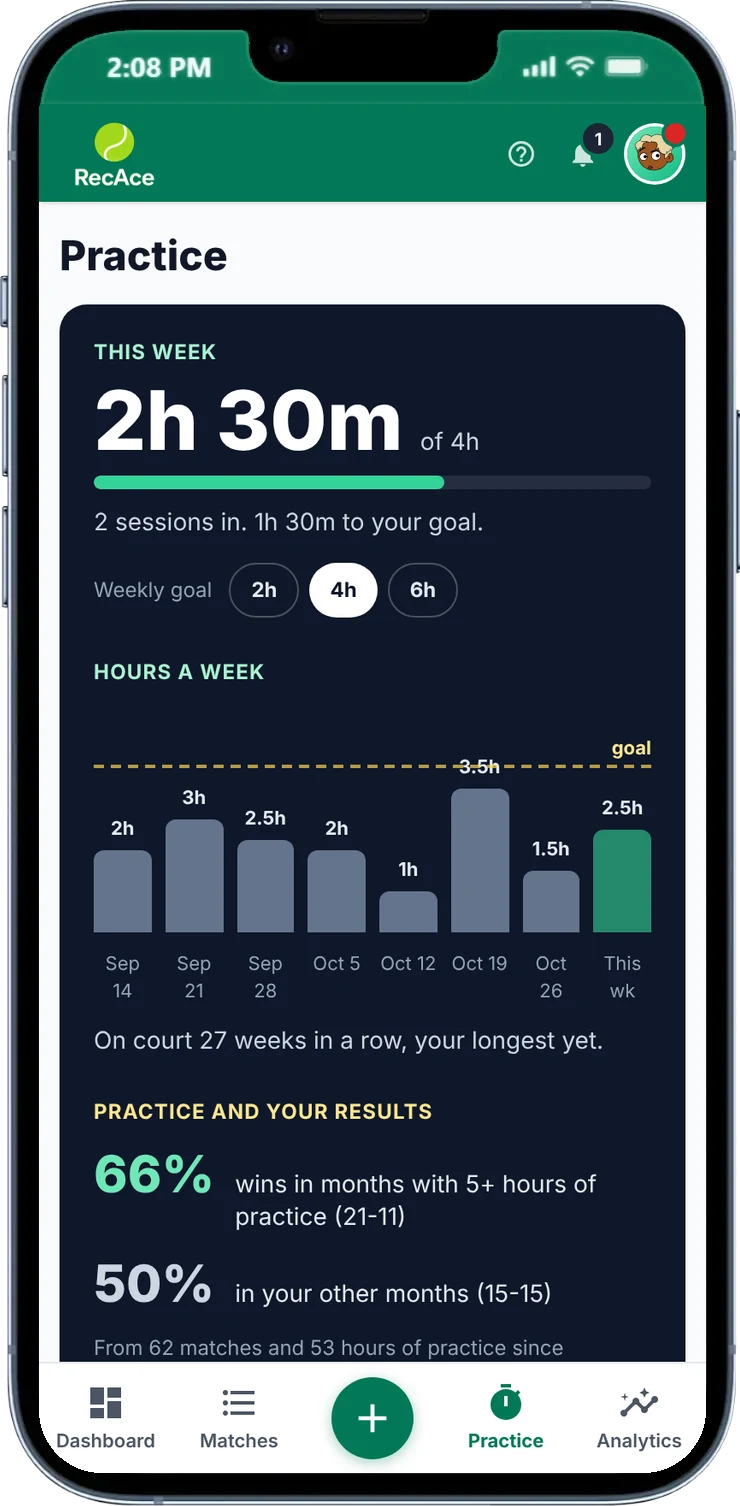
Juniors spend far more time practicing than playing matches. Logging lessons, clinics and drills next to the match results lets you answer a question every tennis parent asks: is all this practice paying off?
If match results improve in the months with more court time, you'll see it. If they don't, that's worth a conversation with the coach about what the practice is targeting. We wrote about how to read this in is your tennis practice actually helping?
What College Coaches Look For
If college tennis is on the table, this is where a good match log earns its keep. Recruiting has a lot of moving parts, but coaches tend to look at the same handful of things.
1. The rating, as a first filter
Most college coaches start with a rating to decide who is worth a closer look. UTR is the one you'll see in most recruiting profiles and commitment announcements, and many coaches also check the ITF World Tennis Number. Neither is a cutoff. They're a screen.
Recruiting services publish rough ranges for the UTR it takes to be considered at each level. They vary from source to source and from program to program, so treat these as a starting point:
| Level | Boys (approx. UTR) | Girls (approx. UTR) |
|---|---|---|
| Top Division I programs | 13 and up | 11 and up |
| Division I overall | about 11.5 to 13 | about 9 to 12 |
| Division II | about 9.5 to 12 | about 6 to 10 |
| Division III | about 7 to 12 | about 4 to 9 |
High-academic Division III schools, NAIA and junior colleges each have their own ranges, and a player well inside a range can still be passed over while one just under it gets a call. If you want to see where a number sits on the adult scale, the UTR to NTRP chart helps.
2. The trend
A coach recruiting a 15-year-old is guessing where that player will be at 18. A UTR that has climbed steadily for two years says more than a single number. So does the pattern underneath it: closer scores against the same opponents, more three-set wins, losses that used to be 6-1 turning into 7-5.
This is the part a match log shows and a rating page doesn't. You can point to it.
3. Who your player has beaten
Coaches look past the rating to the results behind it. Wins over higher-rated players stand out. So do tight losses to players already committed to college programs. Keeping each opponent's rating on the day you played them is what lets you say "beat a 9.8 while rated 9.1" months later instead of guessing.
4. Video
Almost every coach will ask for match video before going further. A few unedited sets against a strong opponent are worth more than a highlight reel. Film from behind the baseline, high enough to see the whole court, and note the opponent's name, rating and the score so the coach can look it up.
5. Grades and test scores
Academics matter at every level and decide a lot at Division III and the high-academic schools. Coaches want a transcript early. Players hoping to play Division I or II also need to register with the NCAA Eligibility Center and take the required core courses, so check those rules with the high school counselor by the start of high school.
6. Character and coachability
Coaches watch how a player handles a bad line call, a lost first set and a parent in the stands. They talk to the junior's coach. They notice who writes the emails, the player or the parent. It should be the player.
The Recruiting Timeline
Every family's path is different, but this is the usual shape:
- Freshman year: play a full tournament schedule, keep the match log, keep grades up. Start a list of schools that fit academically, athletically and on cost.
- Sophomore year: make a short recruiting profile (UTR, results, video, transcript). Email coaches at schools on the list and go to camps or unofficial visits where you can. Under current NCAA rules, Division I and II coaches can start direct contact on June 15 after sophomore year.
- Junior year: the busiest year. Coaches call, visits happen, and many Division I offers come during this year or the summer after.
- Senior year: remaining offers, official visits, signing, and making sure eligibility paperwork is done.
Recruiting rules change often. Recent changes to Division I roster sizes (a 10-player limit in men's and women's tennis at schools that adopted it) have shifted how many spots and scholarships each team has. Check the current NCAA calendar and talk to coaches directly rather than relying on last year's advice.
What to Send a College Coach
A first email from your player should be short and easy to check:
- Name, graduation year, high school, hometown
- Current UTR (and WTN, if they have one) and the link to their profile
- Three to five best results from the last year, with the opponent's rating at the time
- Upcoming tournaments where the coach could watch
- A link to unedited match video
- GPA and test scores, if taken
- The junior coach's name and contact
This is where a season of tracking pays off. Instead of digging through old draws, you look down the season's results next to each opponent's rating, pick the best wins, and copy them into the email. Export the full history to a spreadsheet and you have a results list ready for any coach who asks.
Using RecAce for a Junior Player
RecAce is a free match tracker for tennis and pickleball, and everything above maps onto it directly:
- Log the match in the car. Say it ("Lost to Maya Chen 6-4, 3-6, 10-8, she was a lefty and served wide all day") and RecAce fills in the opponent, score and result and keeps the rest as notes. Nothing saves until you check it. Or tap the score into the boxes. Match tiebreaks and pro sets work.
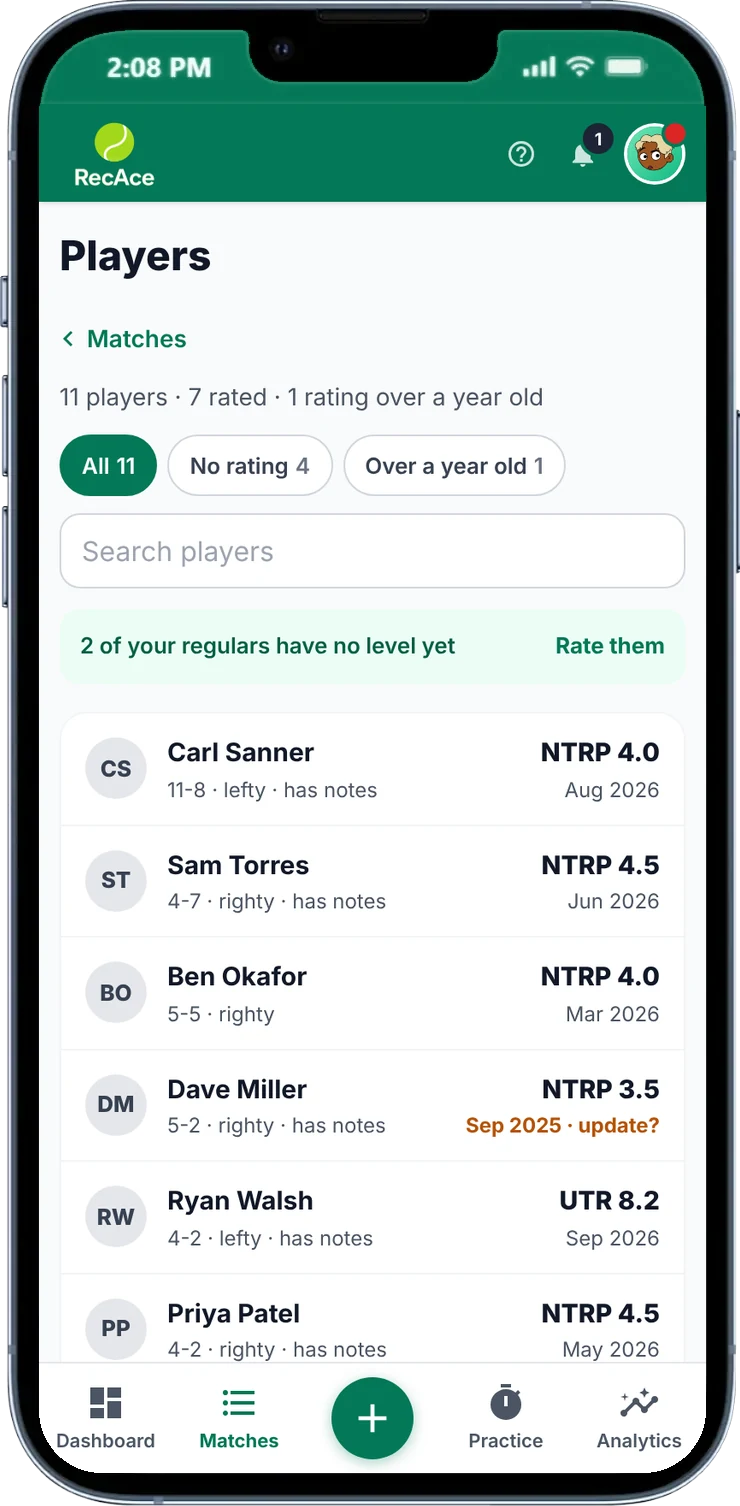
- Opponents' ratings with dates. The Players page keeps each opponent's UTR or NTRP, their hand and private notes, and flags a rating that's more than a year old.
- Head-to-head for every opponent: record, last five, sets won, every meeting and every note.
- A rating after every match, starting from your player's UTR or NTRP level.
- Tournament results: mark a match as tournament or league and record Champion or Runner-up, so titles and finals show in the match list.
- Practice and lessons in their own tab with a weekly goal.
- Export the full history to Excel or CSV whenever you need it, for a coach or a recruiting profile.
Profiles are private unless you choose to make one public, and leaderboards are opt-in, which matters when the player is a kid.
A note on accounts: RecAce is set up for the person keeping the log to hold the account. For younger players, that means a parent keeps the log under the parent's own sign-in and logs the matches from the player's side of the net. Older teens who want to log their own matches can start their own account.
A season of scores, opponents and ratings, in one place.
Log your player's last match in about a minute. Head-to-head records, ratings and practice build from there. Free, with no ads.
Start Your Junior's Match Log FreeA Season-End Review
Once a season, sit down with your player (and the coach, if they're up for it) and look at the whole year:
- Record by event level. Are they winning more at the level they're playing, or is it time to move up?
- Record against higher-rated opponents. This is the number that tells you whether a jump in UTR is coming.
- Three-set matches. Winning most deciding sets usually means fitness and nerves are holding up. Losing most of them is a coaching topic.
- The rivalries. Which opponents went from losses to wins this year?
- What the notes keep saying. If "double faults under pressure" shows up in five losses, that's next season's focus.
Done this way, a year of junior tennis turns into a clear story instead of a blur of Saturdays. And if college tennis is a goal, it's the start of the record coaches will want to see. For more on reading a season, see our guide to the year-over-year mindset.
Quick Answers
What should I track for my junior tennis player? At minimum the opponent's name, the score, the date and the event. Add the opponent's UTR on the day, surface, the opponent's hand and a line of notes whenever you can.
Does UTR show my child's match history? UTR shows verified results that feed the rating. It doesn't keep your notes, your player's practice, or matches that never reach UTR, such as practice sets, many club matches and some local events. A personal log keeps all of it.
What UTR do you need to play college tennis? There's no fixed number. As a rough guide, Division I boys are usually 11.5 and up and girls 9 and up, with top programs higher. Division II and III ranges are lower and wider. Coaches also weigh the trend, wins over higher-rated players, video and grades.
When can college tennis coaches contact my child? Under current NCAA rules, Division I and II coaches can start direct recruiting contact on June 15 after the player's sophomore year. Your player can email coaches before that. Check the NCAA calendar each year, because the rules change.
How do college coaches look at junior results? UTR is usually the first filter. After that, coaches look at results against strong opponents and whether the trend is improving. A clean record of wins, scores and opponent ratings makes that easy to show.
Can a parent track a child's matches in RecAce? Yes. The parent keeps the log under their own account and logs the matches from the player's side. Profiles stay private unless the parent makes one public.
Is RecAce free for juniors? Yes. Match logging, head-to-head records, the rating, practice tracking and export are free. Pro adds odds against each opponent, more Crystal Ball game plans before a rematch, more Coach's notes readings and the full rating history.