


You are playing Dave on Saturday. You have played him four times. You know you lost the last one, you have a vague memory of being furious about something in the second set, and that is about where your recall stops.
The annoying part is that the details are not actually gone. They are sitting in RecAce, in four match records and whatever you typed in the notes field afterward. You just have no practical way to pull them together twenty minutes before you walk on court.
That is the gap two new features are built to close. Both start from the + button in the app.
What the Crystal Ball actually does
Type in an opponent's name and it gives you four things: your chance of winning, a scoreline it expects, the numbers it read to get there, and a game plan.
The percentage is the part people ask about first, so here is exactly where it comes from. RecAce converts your rating and your opponent's rating onto a common scale, so an NTRP number and a UTR number can be compared without pretending they are the same thing. That produces a baseline expectation. Then it blends in your actual record against that person, weighted by how many times you have played them, because two matches and twelve matches should not carry the same authority. Finally it pulls the whole thing toward 50 percent when the sample is thin.
That last step is the one that keeps it honest. A player with one win against someone does not have a 100 percent win rate in any meaningful sense, and a prediction that says otherwise is just flattering you.
The arithmetic is RecAce's own. Claude, the AI that writes the report around it, is handed that number and required to quote it. It cannot nudge the percentage because it thinks you sound like you are due for a win.
The rule that keeps the report from being useless
Here is the failure mode we were most worried about. Ask any AI for a pre-match report and it will happily produce "stay aggressive, control the center of the court, and play with confidence." That is worse than shipping nothing, because it wastes your time while sounding like advice.
So every observation in a Crystal Ball report has to cite a specific number from your own history. Not a general principle, not a plausible-sounding tennis truism. An actual figure, printed underneath the claim so you can check it.
In practice that means you get lines like "you are 0-2 against Josh, both in singles on hard courts" with the record printed below it, or "Josh is 6.74 UTR versus your 5.5 UTR." If the system cannot point at one of your numbers, it is structurally unable to make the claim. When your history with someone is thin, you get two well-grounded points instead of six vague ones. That is the correct outcome, not the feature falling short.
Your own match notes turn out to be the most valuable thing in the whole report. A line you typed after a loss in June about running out of gas in the third set is more tactically useful than any rating comparison, and the report treats it as your recollection rather than established fact, and attributes it back to you.
Prove it wrong
When the Crystal Ball picks against you, it says so plainly and then dares you to prove it wrong. The game plan below it changes heading to match.
This was deliberate. A prediction that only ever flatters you is entertainment with no edge, and a prediction that tells you you are going to lose with no path forward is just discouraging. Being told you have a 17 percent chance, along with three specific things your own record says to do about it, is the version that makes you want to play.
You can watch the Crystal Ball run start to finish if you would rather see it than read about it.
The other half: just talk about the match
The Crystal Ball is only as good as what you have logged, and logging is exactly what people stop doing. Filling in eight form fields with your thumbs while standing at the fence is a chore, and the match you skip is the one you needed later.
So Say your match lets you say it out loud instead. Tap the mic, talk, and the match form comes back filled in for you to check.
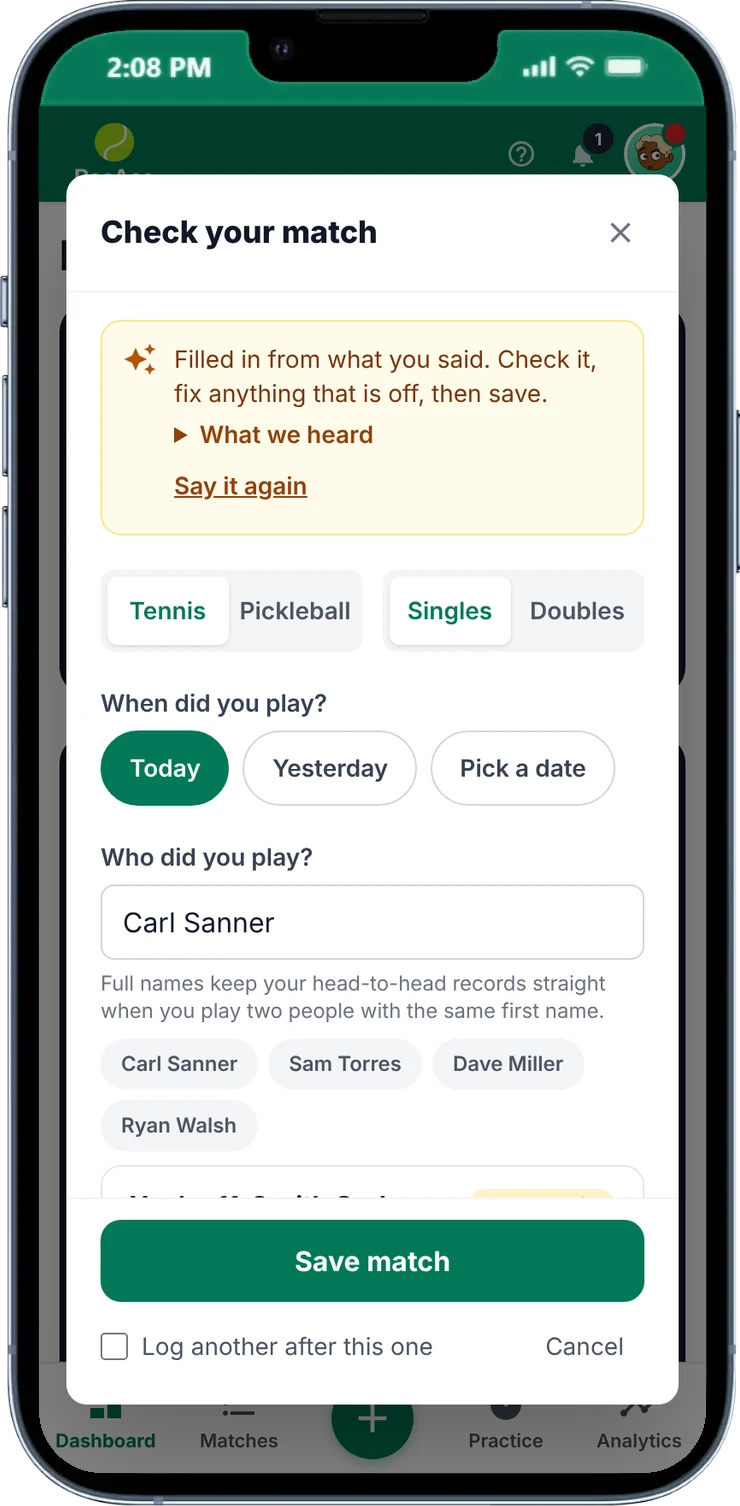
"I beat Mike Hudson today 7-5 in the first and 6-4 in the second, he was a pretty good player but he struggled with his backhand, I think I can beat him more easily next time if I serve there more" comes back as a date, an opponent, a score, a result, a location, and a note about the backhand.
That last part is the bit worth understanding. Everything you mention beyond the bare facts becomes your match notes. Which means the fastest way to log a match is also the way you end up with the richest notes, and those notes are what the Crystal Ball reads before your next meeting with the same person. Talk for twenty seconds today and you have written the most useful paragraph in a report you will read six months from now.
Nothing saves on its own. The parse fills in the normal add-match form, score validation runs exactly as if you had typed it, and you review it and submit it yourself. You can see a match logged by talking too.
What it costs
Both tools are open to every account. Free accounts get 3 Crystal Ball readings and 10 Say your match entries a month. Pro raises that to 50 and 100.
That split is intentional. Pro raises the ceiling instead of unlocking the door, because the only way you will know whether any of this is worth paying for is to use it on your own matches and decide. Checking what RecAce already knows about an opponent is free and unlimited, and a request that fails never counts against your allowance.
What we do not do with your data
Nothing is sent anywhere unless you press a button. If you never use either tool, nothing about your matches goes to them.
When you do use it, a Crystal Ball reading sends the statistics we calculated plus your notes about that one opponent. Say your match sends the description you wrote. Your name, email, password, and payment details are never part of it. We keep each Crystal Ball reading, encrypted, so you can open it again on that opponent's page, and Anthropic does not train its models on data submitted through its API. The privacy policy has the full accounting in section 10.
It is still just a formula
The prediction is for fun, and the app says so under every one. It is arithmetic reading a handful of your matches, not a scout who has watched your opponent play for a season. It does not know that Dave has been taking lessons since April, or that your shoulder has been bothering you.
Some of the best matches you will ever play are the ones where the number was wrong. That is rather the point of showing it to you.
Both tools are live now. There are full guides for the Crystal Ball and Say your match, and if you are new to keeping records at all, start with why the year over year view is where the real insight shows up. You can also read more about RecAce as an app for tracking tennis match stats or for tracking pickleball stats.