


Two players walk off court after a 7-6, 4-6, 7-6 match. Both played well. Both hit similar groundstrokes. The difference came down to seven points in the first tiebreak and seven more in the third. That is the part of tennis nobody trains for, and the part nobody tracks.
If you have been playing competitively for any length of time, you already know the feeling. A set hangs on a couple of decisions at 5 points all. You either find the answer or you go home with a loss that did not feel like a loss.
This post walks through what your match data can tell you about your tiebreak performance, the specific patterns to watch for, and the small adjustments that turn a 50% tiebreak record into a 65% one.
RecAce logs every set score, including tiebreak results. Once you have 10 to 15 close sets in your history, you can see your tiebreak record next to your overall win rate (one of the Patterns in your numbers), how you do in deciding sets, and which opponents tend to outlast you. Start tracking free.
Why Tiebreaks Deserve Their Own Stat Line
Win-loss record is the headline number, but it hides the texture of how matches actually finish. A player who wins 60% of matches and 40% of tiebreaks has a very different problem than a player who wins 60% of matches and 70% of tiebreaks. The first is leaking close ones. The second is stealing them.
Most recreational players have no idea which group they fall into. They remember a few painful losses and a few clutch wins, but those memories are unreliable. Your brain stores the 6-7 in the deciding set; it forgets the routine 7-2 tiebreak from three weeks ago.
That is why tracking your match record matters more in tiebreak analysis than almost anywhere else. The pattern only shows up in the data.
The Three Tiebreak Numbers Worth Pulling Up
When you log enough sets, three specific numbers tell you whether tiebreaks are an asset or a liability for your game.
1. Tiebreak Win Rate vs. Overall Win Rate
If your overall win rate is 55% and your tiebreak win rate is 55%, you are who you think you are. If your overall is 55% and your tiebreak rate is 35%, you are losing matches you have already played well enough to win.
A meaningful gap (10 percentage points or more) usually points to one of three causes: serving issues at high pressure, predictable return patterns that opponents start exploiting, or a mental dip in the 5-5 to 6-6 range.
2. Tiebreak Performance by Match Type
Pull up your tiebreak record split by singles versus doubles, and by competitive league play versus casual matches. Most players find a real difference. The casual match tiebreak rate is often 10 to 15 points higher than the league tiebreak rate, which tells you exactly how much pressure is costing you.
The same effect shows up across formats. Some players are clutch in best-of-three with regular ad scoring but fall apart in 10-point match tiebreakers in lieu of a third set. The format reshapes the pressure curve, and your data will show it.
3. Tiebreak Record Against Specific Opponents
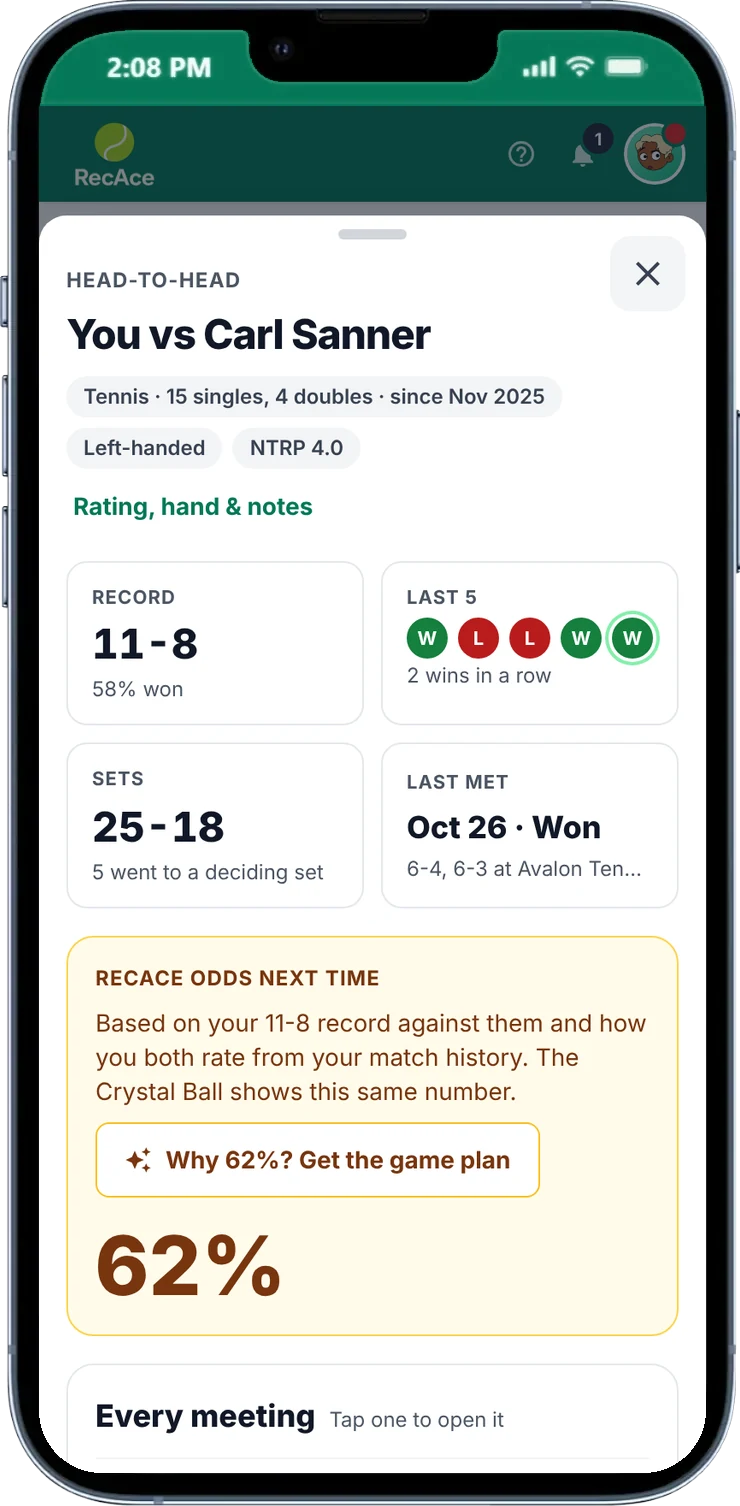
This is where head-to-head tracking earns its keep. You may be 4-2 against an opponent overall but 1-4 in tiebreaks against them. That asymmetry is a signal. They are not better than you across the board, they are better than you in the moments that decide sets.
Once you see the pattern, you can prepare for it. (See the section on beating your tennis nemesis for a full framework.)
The Patterns That Show Up in Tiebreak Data
After you have logged 30 to 50 close sets, certain shapes start to appear. Here are the four most common, and what each one usually means.
Pattern A: The Slow Starter
You lose the first three or four points of the tiebreak almost every time. You then either climb back to 5-5 and win, or you climb back and lose 7-5.
This is a focus issue, not a skill issue. Tiebreaks reset the rhythm of the set. Players who walk to the towel and let their attention drift between 6-6 and the first serve of the tiebreak get punished for it. The fix is a routine: same towel, same bounce count, same target. Boring is the goal.
Pattern B: The Mini-Break Leaker
You hold serve all set, then drop two service points in the tiebreak. Your serve points won percentage is fine across the set but craters in tiebreaks specifically.
Most often, this is a tactical issue. You have been serving wide all set and the opponent has finally adjusted, or you are going for too much on the first serve at the most pressure-sensitive moment. The data points to a serve diversification problem, not a serving problem.
Pattern C: The 5-5 Wall
You reach 5-5 in tiebreaks consistently. You then win about 30% of them.
This is the hardest pattern to fix because it is mental. The first 10 points feel like a normal set; the last few feel like a different sport. Your data will show that your unforced error rate spikes after 5-5. The fix usually involves practicing pressure points specifically, playing tiebreaks from 5-5 in practice sets, or starting matches with a 10-point tiebreak warmup.
Pattern D: The Surface Swing
Your tiebreak record on hard court is 65%, and your tiebreak record on clay is 35%. Or some other meaningful split by surface or venue.
This usually means your tiebreak game depends on a specific weapon (a heavy serve, a fast first-strike pattern) that surface conditions either reward or neutralize. Knowing it is half the work; the other half is building an alternate plan for the surface where it does not work.
What to Log During a Match So the Data Is Useful Later
You do not need to keep a clipboard to capture tiebreak data. The minimum that makes future review possible is this:
- The set score (so 7-6 reads differently from 7-5 in your dataset)
- The tiebreak score itself if you reached one
- A note on what worked or failed during pressure points
In RecAce, that note lives in the match journal field, and Coach's notes reads it once you have built up a sample. After 20 or 30 entries, the language starts to repeat. "Lost focus after the changeover" might appear five times, which is a problem you can train around.
Three Adjustments That Move the Number
Once you have a tiebreak baseline, the question is what to do with it. These three adjustments tend to produce the biggest measurable changes for recreational players.
Build a Pre-Tiebreak Routine
Every player needs a 30-second sequence between the last point of the set and the first serve of the tiebreak. Walk to the towel. Take three breaths. Pick the serve target. Pick the second-serve fallback. Then walk to the line.
This sounds trivial. It is not. The biggest tiebreak losses come from playing the first two points on autopilot. A routine forces a reset.
Pre-Decide Your Pressure Patterns
Decide, before the match starts, what you will hit at 5-5 and at 6-6. Not in the moment. Before. A wide serve to the deuce, a slice return to the backhand, whatever your highest-percentage option is. This eliminates the worst kind of pressure, the kind that comes from in-point decision making.
Opponent scouting notes make this much easier. If you know an opponent struggles with low slice returns, you write that into your scouting report and you reach for it without thinking when the score reaches 5-5.
Practice the Last Five Points, Not the First Five
Most practice sets start at 0-0. They rarely reach a tiebreak. So most players spend zero practice time on the situation that decides their close matches.
Fix it: in your next practice session, play three tiebreaks from 5-5. Then play three from 6-6, server's choice of side. The first time you do it, the situation will feel uncomfortable. By the third session, the discomfort will be gone, and so will half the pressure you used to feel in real matches.
What the Data Eventually Shows
When you have logged 40 to 50 sets across a season, the picture sharpens.
You will see your tiebreak win rate as a number, not a feeling. You will see whether the gap to your overall win rate is closing or widening. You will see which opponents own you in pressure moments and which ones you own. You will see whether your year-over-year improvement curve is real or just a comfortable story you tell about a few good wins.
The players who improve the fastest at the recreational level are not always the ones with the best technique. Often, they are the ones who notice that they win 70% of routine sets and 35% of tiebreaks, and decide that the 35% is the problem worth solving.
Start the Pattern This Season
You probably have a tiebreak coming up this week. You do not know your tiebreak win rate. You can fix that with one habit: log your sets, including the tiebreak score and a one-sentence note about how the close points went. After a month, pull up the data and look for the patterns above.
Create your free RecAce account and start with your next match. Your tiebreak record is one of the most actionable numbers in your tennis game. Most players never see it. The ones who do tend to win the next one.