


You played three matches last week. Can you remember the scores? What about the opponent's tendencies? The conditions? Whether you served first? Most players forget the details within 48 hours. A tennis and pickleball match journal fixes that, and it does more than preserve memories. It reveals the patterns that actually make you better.
Journaling your match results is the simplest form of deliberate improvement. You don't need a coach watching every point. You don't need video analysis equipment. You need a consistent habit of recording what happened and periodically reviewing what the data tells you. Here's exactly how to build a match journal that works.
Why a Match Journal Changes Everything
Memory is unreliable. After a tough loss, you remember the frustration but not the specifics. After a great win, you remember the feeling but not the tactical adjustments that made it happen. A match journal captures the facts before your brain rewrites them.
Over time, those facts compound into something useful: a complete record of your competitive history. Players who track their matches consistently develop a level of self-awareness that casual players never reach. They know their win rate. They know which opponents give them trouble. They know whether they're actually improving or just treading water.
The difference between a player who "feels like" they're getting better and a player who knows they're getting better is a match journal.
What to Record in Every Match Entry
The best match journal is one you'll actually maintain. Start simple. You can always add detail later, but you can't go back and reconstruct matches you never logged.
The Essentials (Every Match)
- Date: When you played
- Opponent: Who you played against
- Score: The final score, set by set or game by game
- Win or Loss: Though a good tracker like RecAce detects this automatically from the score
- Sport: Tennis or pickleball (if you play both)
- Format: Singles or doubles
This takes 10 seconds. That's the baseline. If you only record these six things for every match, you'll still build a useful dataset over time.

The Next Level (When You Have a Minute)
- Surface or court type: Hard, clay, grass, indoor. Surface data reveals hidden strengths you won't notice otherwise
- Partner: For doubles, who was your partner? Partnership stats matter
- Match notes: A sentence or two about what happened. "Couldn't return their serve in the third set." "Dominated at the net." "Lost focus after going up 4-1."
- Time of day: Morning or evening? Your performance may vary more than you think
- Location or venue: Useful if you play at multiple clubs or courts
Advanced Journaling (For Serious Improvers)
- Opponent attributes: Handedness, play style, skill level. Build a scouting profile over time
- Energy and fitness level: Rate yourself 1-5. Correlate with results
- Tactical approach: What did you try? Did it work?
- Key moments: Tiebreakers, break points, momentum shifts
The goal isn't to write an essay after every match. It's to capture enough context that future-you can understand what happened and spot trends across dozens or hundreds of matches.
Pen and Paper vs. Spreadsheet vs. App
There are three common approaches to match journaling. Each has tradeoffs.
Pen and Paper
A physical notebook feels satisfying. You can sketch court diagrams, jot free-form thoughts, and keep it in your tennis bag. But paper journals can't calculate your win rate, sort by opponent, filter by surface, or show trends over time. You'll have to do all that analysis manually, and realistically, you won't.
Best for: Pre-match mental preparation and post-match reflection. Not great as your primary stat tracker.
Spreadsheets
Google Sheets or Excel gives you structure and basic calculations. You can set up columns, use formulas for win rate, and sort by any field. But spreadsheets require maintenance. The formulas break. The interface isn't mobile-friendly. Adding head-to-head filtering or chart visualizations takes real effort. Most players who start with spreadsheets abandon them within a few months.
Best for: Players who love building systems. Not great for long-term consistency.
A Dedicated Match Tracker
Apps built specifically for tennis and pickleball match journaling solve the problems that paper and spreadsheets can't. RecAce, for example, lets you log a match in 10 seconds and automatically calculates career stats, head-to-head records, win rate trends, streaks, and more. Your journal becomes a living dashboard that grows more valuable with every entry.
Best for: Players who want the insights without the overhead. The journal habit sticks because the effort is minimal and the payoff is immediate.
How to Review Your Match Journal for Real Insights
Recording matches is step one. The real value comes from periodic review. Here's a simple review cadence that turns raw data into actionable improvement.
Weekly Check-In (2 Minutes)
Glance at your last week of matches. Ask yourself:
- How many matches did I play? Am I getting enough match volume to improve?
- Did I win more than I lost? What was different about the wins vs. the losses?
- Is there an opponent I need to prepare for differently next time?
Monthly Review (10 Minutes)
Look at the broader picture:
- What's my win rate this month compared to last month?
- Are there specific metrics trending up or down?
- Which opponents am I improving against? Which ones still have my number?
- Am I playing enough on different surfaces or at different times of day?
This is where a tool with built-in analytics saves hours. Instead of manually counting wins and losses, you open your dashboard and see the numbers instantly.

Quarterly Deep Dive (30 Minutes)
Zoom out. This is where the journal becomes a coaching tool:
- Compare this quarter to the same quarter last year. Are you better? The year-over-year mindset is the most honest measure of improvement.
- Look at your rating trend if you track it. Is your skill level rising against quality opponents?
- Review your notes for recurring themes. If "lost focus in the third set" appears five times, that's not bad luck, that's a pattern worth addressing.
- Check your head-to-head records against rivals. Has the balance shifted?
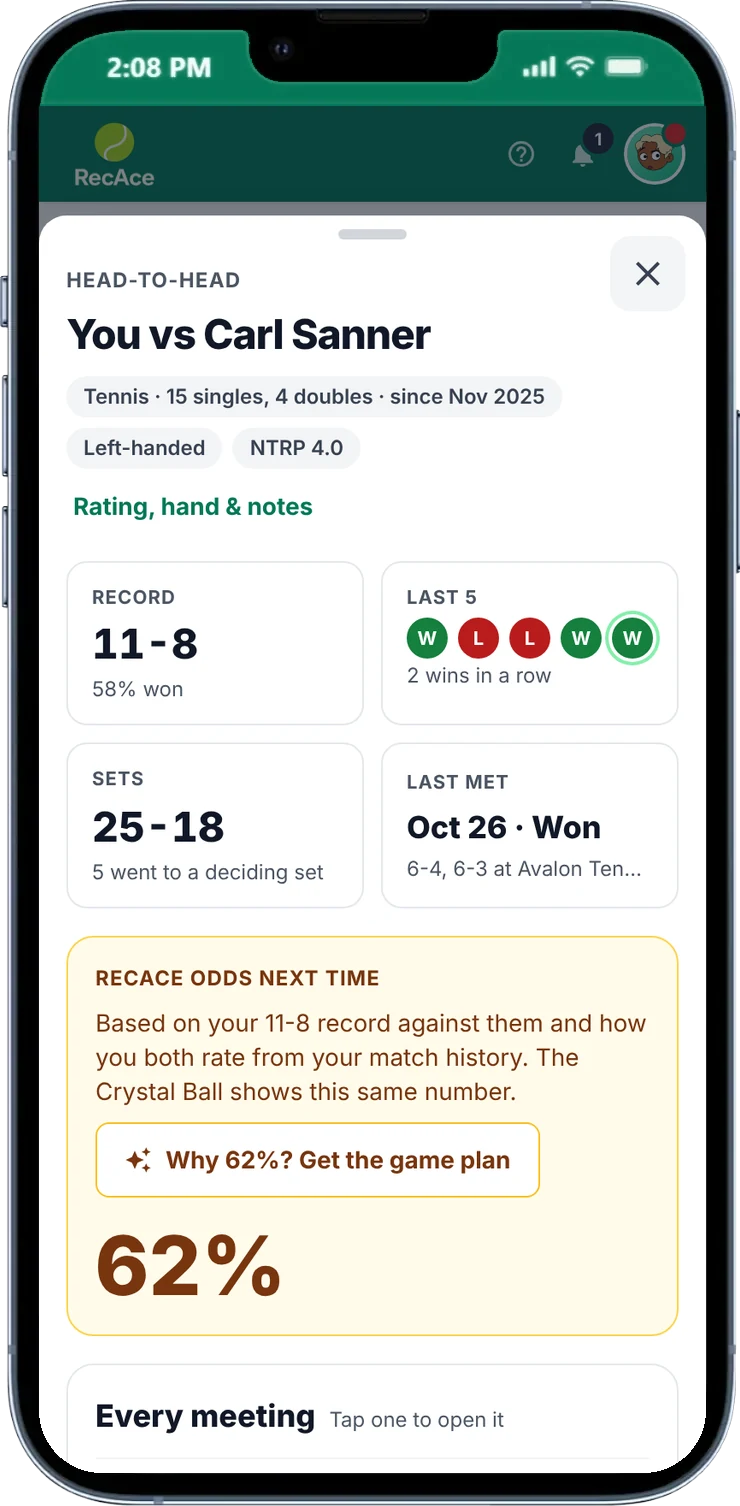
The players who improve fastest aren't the ones who journal the most. They're the ones who review their journal consistently and adjust their practice based on what they find.
Match Journaling for Pickleball Players
Everything above applies to pickleball, but there are a few pickleball-specific journaling considerations.
Track Your Format
Pickleball has more scoring variety than tennis. Whether you're playing rally scoring or side-out, log the format. Your performance may differ significantly between the two, and you won't know without data.
Log Your Partner Consistently
Doubles is the default in pickleball, making partner tracking essential. Over your first 100 games, you'll discover which partnerships produce the best results, and it's not always who you'd expect.
Note the Skill Gap
Pickleball communities often have wide skill ranges playing together. Journaling the approximate level of your opponents (beginner, intermediate, advanced) helps you understand whether your wins are coming from playing down or genuinely competing at your level.
Join or Start a Community
Journaling becomes even more useful when your group tracks together. Building a competitive community with shared leaderboards and challenges gives your journal entries context beyond your own record.
Common Match Journaling Mistakes
Logging Only Wins
This is the most common journaling failure. If you skip logging losses, your data is meaningless. Every match counts. The losses are where the insight lives.
Writing Too Much
A paragraph of notes is fine occasionally. But if journaling feels like homework, you'll stop. Prioritize consistency over detail. A one-line note on every match beats a three-paragraph analysis on every third match.
Never Reviewing
A journal you never re-read is just a diary. The improvement comes from review and pattern recognition. Set a calendar reminder for your monthly review.
Tracking the Wrong Things
Don't obsess over metrics you can't control. Focus on inputs you can change: match volume, surface variety, opponent diversity, tactical experimentation. The right five stats tell you more than twenty random numbers.
How RecAce Makes Match Journaling Effortless
RecAce is built to be the match journal you'll actually keep. Here's why it works:
- 10-second logging: Opponent, score, done. Smart score validation handles the rest
- Automatic analytics: Win rate, streaks, trends, and head-to-head records calculated instantly
- Match notes: Add context to any match with encrypted private notes
- Works on any device: Phone, tablet, desktop. No app store download required
- Free tier covers the essentials: Unlimited match logging, your rating, career stats, H2H records, charts, and friends and clubs at no cost, plus 3 Coach's notes readings a month
- Pro for deeper analysis: odds, Crystal Ball game plans, rating history, every pattern in your numbers, and 20 Coach's notes readings a month for players who want the complete picture
Whether you're a tennis player exploring pickleball or a dedicated competitor in either sport, the habit starts the same way: log your next match.
Start Your Match Journal Today
You don't need a perfect system. You need a consistent one. Log your next match, opponent, score, date, and do it again after the next one. Within a month, you'll have data. Within three months, you'll have patterns. Within a year, you'll have a complete competitive history that no amount of memory could replicate.
The best time to start a match journal was your first match. The second best time is your next one.
Create your free RecAce account and log your first match in under a minute. Check the FAQ if you have questions about getting started, or visit Why RecAce to see how it compares to other approaches.