


The third shot is the most discussed ball in pickleball. The serve goes long and deep, the return comes back even longer, and now the serving team is stuck near the baseline with one job: get to the kitchen line without giving away the point. The question every team faces, every rally, is whether to float a soft drop into the no-volley zone or rip a drive at the returners' feet.
There is no single right answer. The drop is the safer play and the foundation of high-level doubles. The drive is the higher-variance option, capable of stealing a point outright or coughing up a sitter. The right choice depends on your opponents, the return you got, your partner's positioning, and what is working that day.
This post lays out the decision framework, when each shot tends to win points, and how to use match tracking to figure out which approach gives your team the better win rate.
RecAce lets you tag each pickleball match with notes about your third-shot approach. After 20 to 30 matches, you can compare your win rate on drop-heavy days versus drive-heavy days against similar opponents. That kind of self-scouting comes out of your own match data, not generic advice.
What the Third Shot Actually Is
In a pickleball point, the first three shots are scripted in a way most other rallies are not. The serve must be deep and bounce in the service box. The return should be deep too, ideally pushing the serving team behind the baseline. The third shot is the serving team's only chance to neutralize that disadvantage and earn the right to move forward.
The serving team starts the rally with two big handicaps. They are stuck deep, and they cannot move to the kitchen until the ball bounces a second time. The returning team, by contrast, gets to charge straight to the kitchen line after their return. By the time the third shot is struck, the receivers are already at the net, and the servers are still scrambling to catch up.
The third shot has to do one of three things: stop the receivers from attacking, slow the rally enough to let the servers reach the kitchen, or end the point outright with a winner. The drop usually does the first two. The drive sometimes does the third.
The Third Shot Drop
A drop is a soft, arcing shot that lands in the kitchen, ideally low enough that the receivers have to scoop it up rather than volley it down. A clean drop forces the receivers to hit a soft, defensive ball, which gives the servers time to walk forward and join them at the kitchen line.
The drop is the foundation of consistent doubles for a few reasons:
- It is repeatable. A 4.0 player can hit a respectable drop six or seven times out of ten. The same player hits clean winning drives much less often.
- It does not give the point away. A drop that misses long lands at the receivers' feet, which is not great but rarely an outright winner for them. A drive that misses goes into the net or sails.
- It moves the servers forward. Even a mediocre drop slows the point down enough for the team to make ground.
Drops also expose the receivers' kitchen skills. Recreational pickleball is full of 3.5 and 4.0 players who can hit a confident return from the baseline but freeze when asked to volley a soft ball off their shoelaces. Against those opponents, the drop is not just safe, it is the higher-percentage play.
The Third Shot Drive
A drive is a hard, flat shot aimed at the receivers, usually at body height or below. The goal is to create a difficult volley, force a pop-up, or simply win the point outright before the receivers can settle in.
The drive's advantages are real but conditional:
- It works against weak volleyers. A 3.5 receiver who cannot reliably block a hard ball will give you free points.
- It works on short returns. If the return lands mid-court instead of deep, you are already inside the baseline and a drive is a much higher-percentage shot than from ten feet behind the line.
- It works as a mix-up. A team that has been getting drops all match starts creeping forward and pinching the middle. A surprise drive at their feet or hips resets their positioning and buys you several easier points in the rallies that follow.
The downside is variance. A drive that goes long is a clean loss. A drive that pops up at the kitchen is a clean loss. The receivers, already in the better court position, will punish any mistake. If your drive win rate is much worse than your drop win rate, the drive is costing you points even when it feels satisfying.
The Decision Framework
A simple way to make the call in real time:
Drop when the return was deep and at your feet. You are not in position to drive accurately. A drive from ten feet behind the baseline is mostly a hope.
Drive when the return floated short. You are inside the baseline, on balance, and the ball is at a comfortable contact point. This is the situation where the drive's risk falls and its reward stays the same.
Drive when the receivers cannot handle a hard ball. Two or three drives early in the match will tell you. If they pop everything up, keep driving. If they block cleanly and you are giving up the kitchen anyway, switch back to drops.
Drop when your partner is already at the kitchen. Your partner is the reference point. If they have moved forward, the drop is the shot that lets you join them. A drive often pulls the play in a direction that strands you.
Mix in a drive every five or six points even when drops are working. Predictability is the biggest gift you can give an opposing team at the kitchen line. A single drive at body height resets their expectations and makes the next drop more effective by contrast.
For more on reading opponent tendencies in real time, see our opponent scouting guide.
How to Track Which Approach Is Working
This is where pickleball-specific match tracking earns its place. Most apps either ignore strategy questions or bury them under stats that are too granular to log honestly. The version that actually works for recreational players is simple.
Log every doubles match with one note: "drop heavy", "drive heavy", or "balanced". You do not need shot-by-shot data. You need an honest summary of which third-shot approach you and your partner emphasized that match. Five seconds at the end of the game is enough.
After 20 to 30 matches, look at three things:
- Win rate by approach. Compare your drop-heavy matches against your drive-heavy matches. A 10 percentage point swing or larger is meaningful.
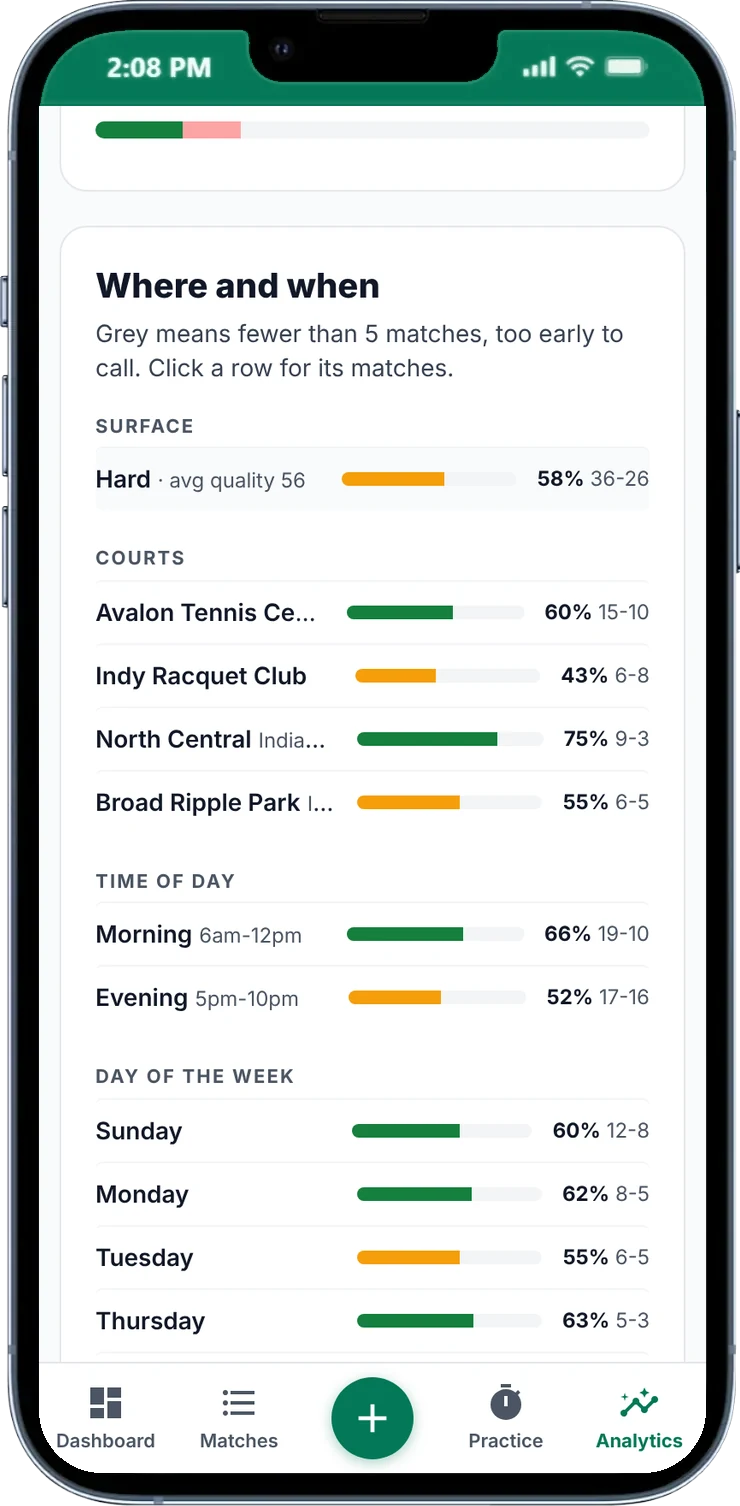
- Win rate against the same opponents. If you have played the same team multiple times with different third-shot approaches, that is your cleanest comparison. The H2H view in RecAce lists every meeting with that opponent next to the notes you wrote after each one, so the comparison is easy to make.
- Win rate by partner. Your best third-shot approach might depend on who you are playing with. Drops require both partners to move forward together. Drives reward partners who can poach the resulting pop-up. Your doubles partner stats will often show different patterns with different partners.
The point of this exercise is not to find a single answer. It is to find which approach gives you and a specific partner the best results against a specific kind of opponent. That is a meaningful piece of game-planning intelligence that does not exist anywhere in your memory.
Common Mistakes That Skew Your Data
A few traps to watch for when you start tagging matches this way.
Confirmation bias on note-taking. If you went into the match planning to drive, you might log "drive heavy" even if half your third shots were drops. Try to record what actually happened, not what you intended.
Mixing in tournament matches without flagging them. Tournament play involves different opponents, longer days, and more pressure. Pickleball tournament matches deserve their own bucket. Our pickleball tournament prep guide goes deeper on how tournament data should be analyzed separately.
Treating every partner the same. Drops are a two-person commitment. If your partner does not move up with you, the drop strands you at the kitchen alone. That is a partner problem, not a shot-selection problem.
Forgetting to log losses. Selection bias kills these analyses faster than anything else. Log the bad matches with the same level of detail as the good ones, including which approach you used. Otherwise your data only proves what you wanted to believe.
Stacking, Skill Gaps, and the Third Shot
If you are already using formations like stacking, the third-shot decision interacts with where each partner ends up at the kitchen. A stacked team with a designated poacher on the ad side will get more value from drops, because the drop creates the kind of soft ball that the poacher can step in on. A team that relies on power from a single big-driving partner may get more out of drives that set up the next ball.
Skill gap matters too. In a 4.0 plus 3.5 pairing, the 4.0 should usually hit the third shot when the formation allows. A 3.5 third-shot drop is much harder than it looks on TV. Routing the third shot through the stronger partner improves the team's overall percentage even if it requires some unusual positioning to set up.
Drills Are Not Enough on Their Own
You can drill drops in a clinic for years and still pick the wrong shot in a match. The decision is contextual: it depends on the return you got, the receivers in front of you, and the partner next to you. Drilling builds the shot, but matches build the judgment.
This is the same pattern we see in tennis when players ask whether their clinics and lessons are actually translating to wins. The honest answer requires match data, not feel. The third shot is a perfect example: a player can have a beautiful drill drop and a terrible match drop, because the match version requires reading a moving opponent and a deep ball at the same time.
A Four-Week Plan to Find Your Best Approach
If you want a concrete way to use this in your next month of pickleball, here is the lowest-friction version.
Week 1: drops only. In every doubles match, default to a drop. Do not drive unless the return is so short that you are essentially being handed an attackable ball. Log every match.
Week 2: drives only. Same partners, same opponents where possible. Default to a drive on every third shot unless the return pins you well behind the baseline. Log every match.
Week 3: mix by situation. Use the decision framework above. Track what you did and what worked.
Week 4: review and decide. Compare week 1 and week 2 in your RecAce dashboard. Which approach produced more wins? Against which opponents? With which partners?
You will end up with a default approach (almost always the drop, for recreational players) and a short list of situations where the alternative pays off. That is the level of game-planning that lifts a team from "playing whatever happens" to "executing a plan." It does not require shot-by-shot tracking, just an honest log of the matches you actually played.
Start logging your pickleball matches in RecAce and let the third-shot question answer itself.