


Round robins are great for a single afternoon. But if you want ongoing competition that keeps players coming back week after week, a pickleball ladder league is the format that works. Ladder leagues rank players by skill, create natural matchups, and give everyone a reason to play, whether they're fighting for the top spot or climbing from the middle of the pack.
This guide covers everything you need to start a pickleball ladder league at your local club, rec center, or community group. From choosing a format to tracking results, you'll have a working league running within a week.
What Is a Pickleball Ladder League?
A ladder league is a ranking-based competitive format where players are ordered from top to bottom. Players challenge opponents near their position on the ladder. If the lower-ranked player wins, they move up. If the higher-ranked player wins, they hold their spot. Over weeks and months, the ladder sorts itself into a true skill ranking.
Unlike a round robin tournament where everyone plays everyone in a single session, a ladder league runs continuously. Players schedule their own matches within a challenge window (usually one or two weeks). This flexibility is what makes ladders work for adult recreational players, no single day commitment required.
Why Ladder Leagues Work for Pickleball
- Self-scheduling: Players arrange matches on their own time, avoiding the logistics nightmare of coordinating 20 people for one afternoon
- Ongoing motivation: There's always a next match, always a ranking to protect or improve
- Skill-appropriate matchups: You play people near your level, which produces better games than random pairings
- Low barrier to entry: New players can join anytime and start at the bottom, climbing as they earn wins
- Season-long engagement: Instead of one event, you get months of competitive play
Step 1: Define Your League Structure
Before announcing anything, decide on the core parameters.
Singles vs. Doubles
Singles ladder: Simpler to manage. Each player has one ranking. Challenges are one-on-one. Best for groups of 8-30 players.
Doubles ladder: Teams of two are ranked together. Partners must play all matches together. Works well when you have consistent partnerships. Harder to schedule because both players on each team need to be available.
Hybrid approach: Run a singles ladder but allow players to also challenge as doubles pairs on a separate ladder. This gives players two rankings and more playing opportunities.
League Size
- 8-12 players: Intimate ladder. Everyone knows everyone. Minimal management
- 13-24 players: The sweet spot. Enough depth for meaningful rankings but small enough to manage
- 25-40 players: Consider splitting into divisions (A and B) with promotion/relegation between them
- 40+ players: Definitely use divisions. The top and bottom of a 50-person ladder will never play each other, which defeats the purpose
Season Length
Most pickleball ladder leagues run 8-12 week seasons. This gives enough time for the rankings to stabilize and for players to complete a meaningful number of matches. Shorter seasons (4-6 weeks) work for summer programs. Longer seasons (16+ weeks) risk losing momentum.
Challenge Rules
These are the rules that govern who can challenge whom:
- Challenge range: How many spots above their current position can a player challenge? Common ranges are 2-3 spots. A range of 2 keeps matchups tight. A range of 3 allows more flexibility
- Challenge frequency: Limit players to 1-2 challenges per week to prevent burnout and scheduling overload
- Response deadline: The challenged player must accept and complete the match within 7-10 days. If they don't respond, the challenger moves up by default
- Re-challenge cooldown: After two players complete a match, they can't play each other again for 1-2 weeks. This prevents the same two people from endlessly trading positions
The best challenge rules are simple enough to fit on an index card. If players need to read a document to understand how the ladder works, your rules are too complicated.
Step 2: Set Up Rankings and Scoring
Initial Seeding
You have two options for the starting ladder order:
Random seeding: Names are drawn randomly. Fair but chaotic in the early weeks as strong players climb and weaker players drop. The ladder usually sorts itself within 3-4 weeks.
Skill-based seeding: Use existing knowledge of player abilities to create an approximate starting order. This produces competitive matches from day one but requires someone to make subjective seeding decisions.
Hybrid seeding: If your group has been playing together, use past results to inform seeding. If you've been tracking matches with a tool like RecAce, you already have win rates and head-to-head records that make seeding objective instead of political.
How Positions Change
The standard ladder movement rule is simple:
- Challenger wins: Challenger takes the loser's position. Everyone between them shifts down one spot
- Defender wins: No positions change
Some leagues use a modified swap system where only the two players trade positions, leaving everyone else untouched. This is simpler but can create odd rankings when a player near the bottom beats someone at the top.
ELO as a Complement
Traditional ladder position is based on challenges completed. But an ELO rating system can run alongside the ladder to provide a more nuanced skill ranking. ELO accounts for the strength of your opponents, beating the number 1 player moves your rating more than beating number 15. RecAce calculates each player's rating automatically from their match results, giving your league a second layer of competitive intelligence.

Step 3: Choose Your Scoring Format
Pickleball ladder matches need a consistent scoring format. Here are the most common options:
Best of 3 Games to 11
The standard pickleball format. Each game goes to 11, win by 2. Best of 3 games determines the match winner. Takes 30-45 minutes for most recreational matchups.
Pros: Standard format, players are comfortable with it. Cons: Can run long if games go to extra points.
Single Game to 21
One game to 21 points, win by 2. Same total points as a best-of-3 to 11 but played as a single continuous game. Takes 20-35 minutes.
Pros: Faster, simpler, easier to schedule. Cons: No set breaks, less comeback opportunity.
Rally Scoring vs. Side-Out
Decide upfront whether your league uses rally scoring or traditional side-out scoring. Each creates a different pace and feel. Read our complete breakdown of pickleball scoring formats to choose what fits your group. The key is consistency, don't let individual matches use different scoring rules.
Pick one format for the entire season and don't change it mid-league. Players need to know the scoring rules before they challenge someone.
Step 4: Handle Logistics
Communication
Create a group chat (WhatsApp, GroupMe, or Facebook group) for challenge announcements and scheduling. Keep it focused on league business. Post the updated ladder weekly.
Match Scheduling
The beauty of a ladder league is that players schedule their own matches. But set clear expectations:
- Each player must complete at least 2 matches per month (or whatever minimum keeps the ladder moving)
- If a player goes 3+ weeks without playing, they drop 2 positions automatically
- Players who are absent for extended periods (vacation, injury) can request a freeze that holds their position for up to 2 weeks
Court Availability
Ladder matches happen whenever two players find court time. If your club has open play hours, encourage ladder matches during those times. Some leagues reserve specific courts during specific hours for ladder play, but this isn't strictly necessary.
Recording Results
This is where many ladder leagues fall apart. If recording a result requires emailing an organizer or filling out a paper form, people won't do it consistently.
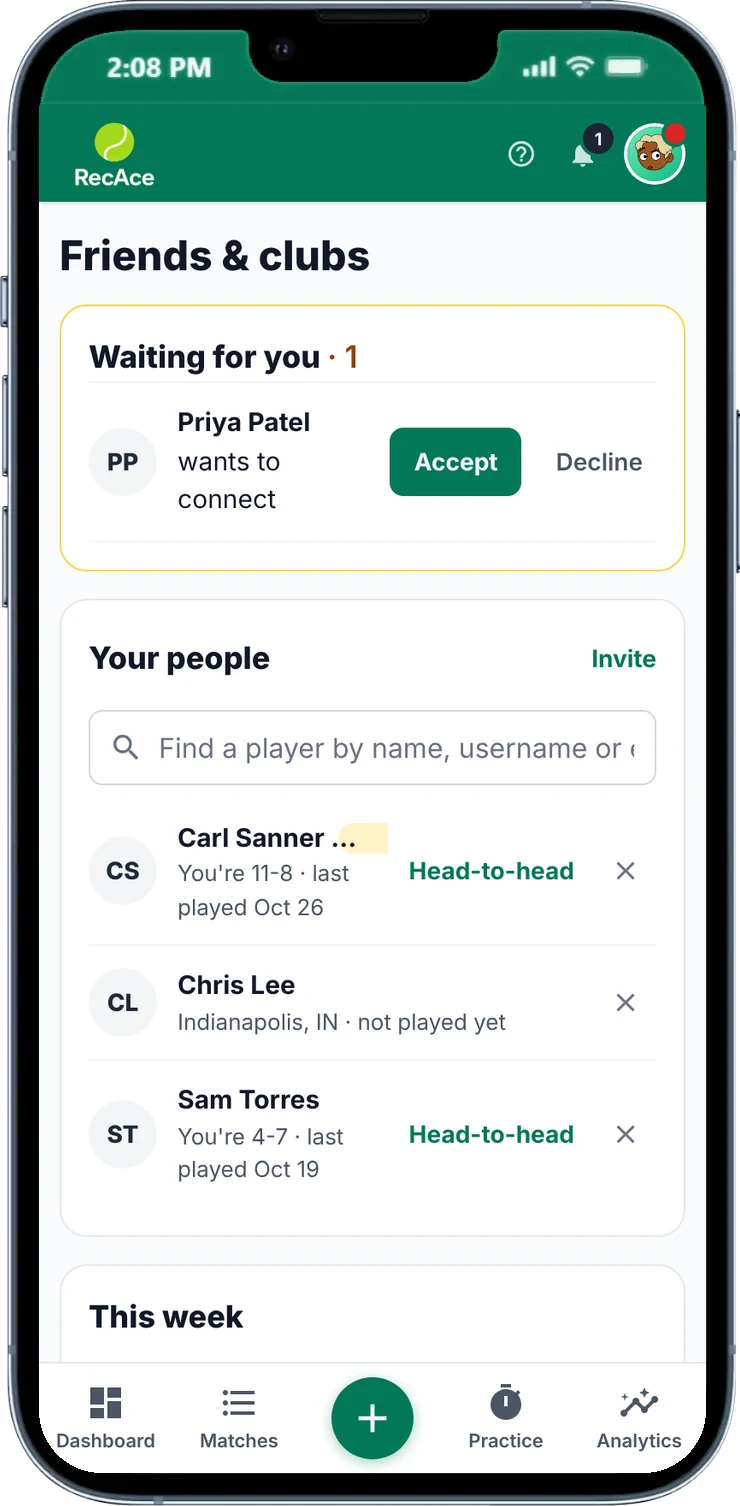
The simplest approach: both players log the match immediately after playing. If your group uses RecAce, either player can log the result in 10 seconds, opponent name, score, done. The app handles automatic win/loss detection, stat calculation, and head-to-head tracking. The organizer can then update the ladder positions from the logged results.
For groups that want shared tracking, RecAce's Clubs feature lets everyone in the league see standings, challenge records, and court leaderboards in one place, all free.

Step 5: Keep the League Engaging
Starting a ladder is easy. Keeping it alive for 12 weeks takes intentional effort.
Weekly Ladder Updates
Post the updated ladder every week, even if only a few positions changed. Seeing the rankings is what motivates players to issue challenges. Include a brief summary: "Sarah climbed 3 spots this week. The top 4 haven't changed. 6 matches were played."
Monthly Highlights
At the end of each month, share stats:
- Most matches played
- Biggest climb
- Longest winning streak
- Tightest match (closest score)
If you're tracking with RecAce, these stats are available automatically. Five key metrics can tell the story of your league's month.
End-of-Season Awards
Give players something to compete for beyond ladder position:
- Ladder champion: Highest position at season end
- Most improved: Biggest climb from starting position
- Iron player: Most matches completed
- Rivalry of the season: The pair with the most head-to-head matches
Promote Friendly Competition
Encourage players to check their head-to-head records against rivals. When you know you're 3-5 against someone, there's a narrative that makes the next challenge feel meaningful. That's the emotional engine of a successful ladder league.
Running a Ladder League for Mixed Skill Levels
If your community has players ranging from beginners to advanced, a single ladder may not serve everyone well. The top players will rarely be challenged, and the bottom players will rarely win.
Division System
Split the ladder into divisions:
- Division A: Top 8-12 players
- Division B: Next 8-12 players
- Division C: Remaining players
At the end of each month (or every 3-4 weeks), the bottom 2 players in each division drop down and the top 2 players in the division below move up. This promotion/relegation system keeps every division competitive.
Separate Ladders by Format
Another approach is separate ladders for singles and doubles. Some players excel at one format but not the other. Separate ladders let players compete where they're strongest while tracking both formats in their overall record.
Ladder Leagues vs. Round Robins: When to Use Each
Both formats build community, but they serve different purposes:
| Ladder League | Round Robin | |
|---|---|---|
| Duration | 8-12 weeks | Single session |
| Scheduling | Players self-schedule | Fixed time, all players present |
| Best for | Ongoing competition | Social events, one-day tournaments |
| Rankings | Evolve over time | Snapshot of one day |
| Management effort | Low (weekly updates) | High (day-of coordination) |
The ideal community runs both: a continuous ladder for competitive structure and periodic round robin events for social play and introducing new players to the group.
Scaling Your Ladder League
Once your ladder is running smoothly, here's how to grow it:
Add New Players Mid-Season
New players join at the bottom of the ladder (or the bottom of the lowest division). They can start challenging immediately. Within a few weeks, their true level will emerge as they win or lose their way to the right position.
Track Long-Term Progress
Encourage players to track their improvement over time. Ladder position is one measure, but personal win rate, rating, and head-to-head records tell a richer story. Players who see their data improving are players who keep showing up.
Connect Multiple Communities
If nearby clubs also run ladders, consider inter-club challenge matches. The top 4 from each ladder play a combined round robin at the end of the season. This gives your best players a new level of competition and builds relationships between pickleball communities.
Tools for Managing Your Ladder League
You can run a ladder league with a whiteboard and a marker. But digital tools make everything smoother:
- RecAce (free): Log matches, track head-to-head records, watch your rating, and use Clubs for group standings. Works on any device with no download required
- Google Sheets: Workable for small groups. Create a shared sheet with the ladder order and update manually after each match. Gets unwieldy above 15-20 players
- WhatsApp or GroupMe: Essential for challenge communication regardless of what tracking tool you use
The combination of a group chat for scheduling and RecAce for stat tracking covers everything most ladder leagues need.
Start Your Ladder League This Week
Here's your action plan:
- Today: Decide on format (singles/doubles), challenge range (2-3 spots), and season length (8-12 weeks)
- Tomorrow: Announce the league to your group. Set a signup deadline 5-7 days out
- Signup deadline: Seed the ladder. Post the starting order. Explain the rules in one short message
- Week 1: Players begin issuing challenges. Post the first weekly update even if only 2-3 matches were played
- Ongoing: Weekly ladder updates, monthly highlights, and consistent enforcement of the minimum match requirement
The hardest part is getting started. Once the first few challenges are complete and players see their name on the ladder, the competitive momentum takes over. If your club runs tennis too, the tennis ladder league guide walks through challenge, box, and points formats.
Create a free RecAce account to give your league a stat-tracking backbone from day one. Check the FAQ for details on clubs and community features, or read Why RecAce to see how it supports competitive groups.