


Watch any good pickleball doubles game and you will notice that most points do not end with a winner from the baseline. They end at the kitchen line, after a patient exchange of soft shots, when one player finally gets a ball that sits up an inch too high and the other puts it away. That patient exchange is the dink rally, and a solid pickleball dinking strategy is what separates players who get stuck at 3.0 from players who break into the 4.0 range.
Beginners tend to treat dinking as a holding pattern, something boring you do until you can hit a real shot. Stronger players understand it differently. The dink rally is where the point is actually decided. The winner is just the receipt. If you can control the kitchen exchange, you control who gets the attackable ball, and whoever gets the attackable ball usually wins the rally.
This post breaks down what good dinking actually looks like, when to keep dinking versus when to speed the ball up, and how to use match tracking to figure out which kitchen patterns are winning you points and which are quietly losing them.
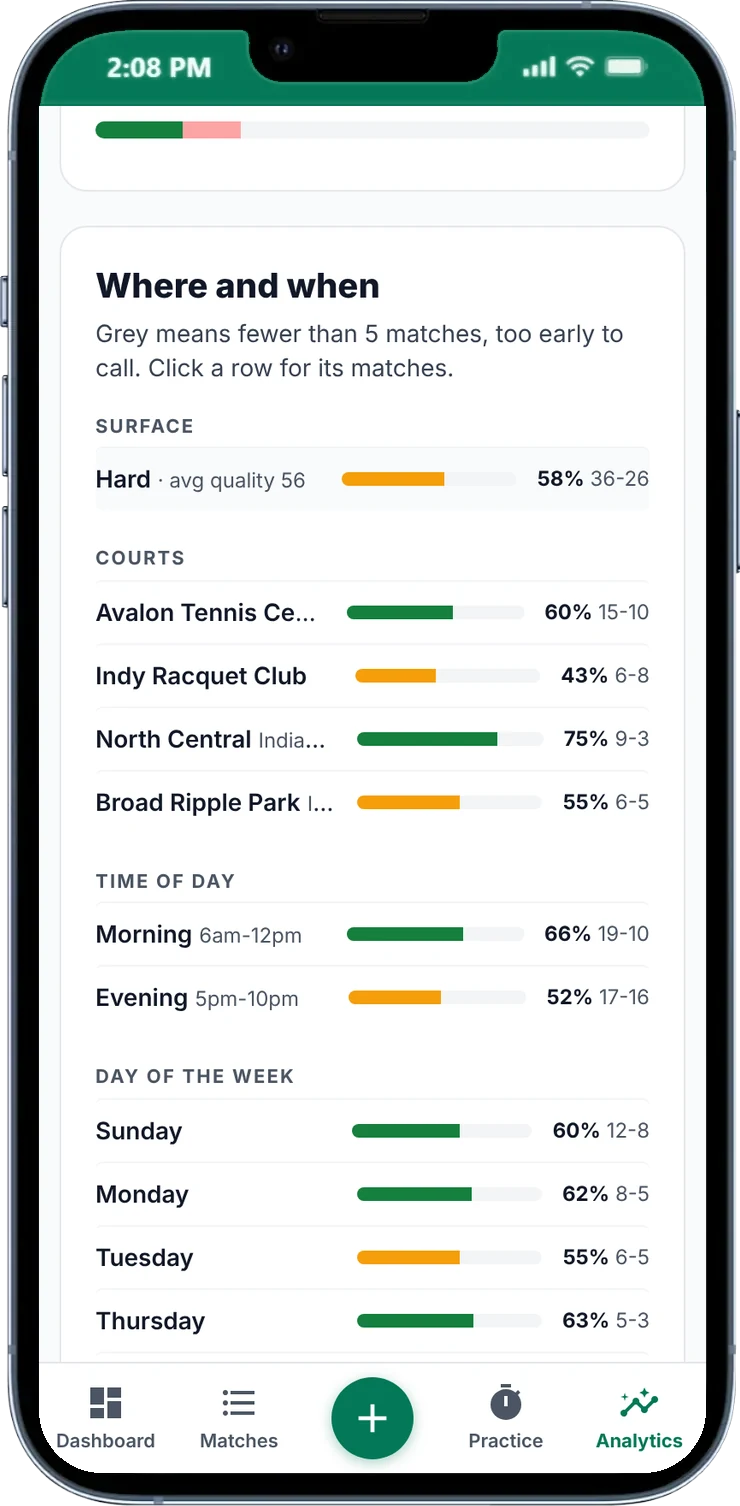
RecAce lets you tag each pickleball match with notes about how the kitchen battles went. After 20 to 30 matches, you can compare your win rate in dink-heavy grinds against fast, banger-style games and see which style actually suits you. That kind of self-scouting comes out of your own match data, not generic advice.
What Dinking Actually Does
A dink is a soft shot, hit on the bounce or out of the air, that lands in or near your opponents' non-volley zone. Because it lands short and low, the opponent cannot attack it. They have to hit up on the ball, which gives it back to you in the same unattackable form.
The entire purpose of the dink rally is patience with a plan. You are not just keeping the ball in play. You are waiting for one of three things to happen: your opponent pops a ball up too high, they get pulled out of position and leave a gap, or they get impatient and try to attack a ball that was not attackable. Any of those three hands you the point.
So a dink rally is really a contest of two questions. Who breaks first, and who forces the break. Players who only answer the first question, by being patient, plateau. Players who answer the second, by actively moving their opponents and setting up the error, keep climbing. Knowing where you sit on that curve helps you set the right goal for your next ten matches.
The Three Dinks Worth Owning
You do not need a dozen variations. You need three reliable ones and the judgment to choose between them.
The Cross-Court Dink
This is your default and your safest option. The cross-court dink travels over the lowest part of the net, has the most court to land in, and gives you the widest margin for error. Most of your kitchen exchanges should live here. When in doubt, go cross-court and wait for a better ball.
The Straight-Ahead Dink
The down-the-line dink is riskier because it crosses a higher part of the net and has less court, but it is your main weapon for moving opponents. Used at the right moment, it pulls a player toward the sideline and opens the middle for your next ball. Use it deliberately, not as a default.
The Push Dink
This is a slightly deeper, firmer dink aimed at your opponent's feet or hip as they stand at the line. It is not an attack, but it is uncomfortable to handle and often produces the pop-up you are waiting for. The push dink is how patient players force the break instead of waiting forever for it.
When to Speed It Up
The hardest judgment in a dink rally is knowing when to stop dinking. Speed up too early on a ball that is too low, and you hit it into the net or hand your opponent an easy counter. Speed up too late, and you let a winnable ball pass. Three signals tell you the moment has arrived:
- The ball is above net height. This is the clearest one. If the ball sits up where you can hit down on it, attack. If it is below the net, keep dinking.
- Your opponent is reaching or off balance. A player stretched wide or leaning back cannot defend a firm ball at their feet. The pop-up does not have to be huge if the opponent is out of position.
- You have moved them out of the middle. If a cross-court and a straight-ahead dink have opened a gap, a speed-up into that gap is high percentage even off a slightly lower ball.
The mistake most improving players make is attacking out of impatience rather than off a real signal. If you find yourself speeding up balls that were below the net, that is a discipline problem, and it shows up in your data as a string of short, error-filled rallies. The decision framework for the third shot covers the same kind of patience-versus-aggression tradeoff earlier in the point.
Positioning: The Quiet Half of Dinking
A dink is only as good as where you are standing when you hit it. Two positioning habits matter most.
First, get to the kitchen line and stay there. Dinking from two feet behind the line is a losing proposition because your soft shots land shorter and sit up more. The whole battle assumes both of you are at the line. If you are not, fix that before you worry about shot selection.
Second, move with your partner as a unit. In doubles, the two of you should slide left and right together, like there is a rope between you. When a cross-court dink pulls your partner wide, you shift to cover the middle. The gap that loses points is the one between two players who moved independently. This is the same chemistry that shows up in doubles partner stats: pairs who move together win more, and the data shows it.
For teams that use stacking to keep their stronger player in position, the same rule applies after the switch. Whatever formation you are in, the two of you defend the kitchen as one moving wall.
How to Track Which Dink Patterns Win
Here is where most players guess and a few players actually know. You can feel like a good dinker and still lose most of your kitchen battles, because feel is unreliable when points are long and similar. The fix is to capture a little structured information and let the pattern surface over time.
A practical approach that does not require a clipboard:
- Tag each match with the style it became. Was it a patient, dink-heavy grind, or a fast bangers' game? One word in the note field is enough.
- Note how the kitchen exchanges went. Short phrases like "popped balls up under pressure" or "won the long dink rallies" build into a pattern after a season.
- After 20 to 30 matches, compare your win rate by style. Many players discover they win 65 percent of patient games and 40 percent of fast ones, or the reverse. That single split tells you which game to steer toward and which skill to drill.
The structured stats tell you what happened. The notes tell you why. Together they turn "I think I am a decent dinker" into "I win the slow games and lose the fast ones, so I need to stop getting baited into speed-ups." That is an actionable conclusion, and you cannot reach it from memory. The broader case for this habit is in our post on tracking your own pickleball stats.
A Drill Plan for the Kitchen
Improvement at dinking comes from reps under realistic constraints, not from hitting a hundred relaxed dinks straight at a partner. Three drills do most of the work:
- Cross-court only. Both players dink cross-court continuously, aiming for control and consistency. Count how many you can string together. This builds the safe default.
- Dink to a target. Place a towel in the kitchen and aim straight-ahead dinks at it. This builds the placement that moves opponents.
- Live speed-up. Dink until someone pops a ball up, then play the point out live. This trains the single hardest judgment, when to stop dinking and attack.
Tennis players crossing over to pickleball often have the hands for this but not the patience, since the skills that transfer between the two sports do not include kitchen discipline. The same nerve that makes a tennis player rush to close out a tight set makes them speed up a dink too early. The cure in both sports is the same: drill the pressure situation until it stops feeling like pressure.
Win the Kitchen, Win the Game
Pickleball at every level above beginner is decided at the kitchen line. The serve and return set the stage, the third shot gets you there, but the dink rally is where the point is genuinely won or lost. A player with a patient, purposeful pickleball dinking strategy beats a harder hitter more often than not, because patience plus placement forces the error that power alone cannot.
Start by noticing which games you win. Log your matches, tag the style, and add a one-line note about how the kitchen battles went. After a month, the pattern will tell you whether to lean into the grind or sharpen your speed-ups.
Create your free RecAce account and track your next session. The dink looks like the boring part of pickleball. It is actually the part that decides who wins.