


Most recreational tennis players have a strong opinion about indoor versus outdoor tennis. Some swear they only play their best game indoors, with no wind and no sun in their eyes. Others find indoor tennis claustrophobic, miss the depth perception cues of an open sky, and play noticeably worse off a backboard of lights and dark ceiling.
Both groups are right about themselves and wrong about everyone else. Indoor and outdoor tennis are different sports in ways that are not obvious from the surface alone. The conditions change ball speed, depth perception, serve timing, and shot tolerance in measurable ways. Whether those changes help or hurt your game depends on what your game actually is.
This post unpacks what is physically different between the two environments, why win rates often split along clear lines, and how to use your own match data to find your real edge.
Indoor and outdoor matches deserve their own bucket in your tracking, just like singles and doubles do. RecAce tags location and surface on every match, and with Pro, Analytics shows your indoor win rate next to your outdoor win rate. After 25 to 30 matches, the gap (or lack of one) is usually visible. More on this in our surface and court data breakdown.
What Actually Changes Between Indoor and Outdoor
The two environments differ on more dimensions than most players realize. The big ones:
No wind, no sun. Indoor play removes the two biggest weather variables in tennis. Ball flight is more predictable, lobs come down where you expect, and the toss on your serve stays in the same place every time. Outdoor play forces you to read conditions on every point.
Lighting and depth perception. Outdoor sunlight gives the ball strong shadows and a clear contrast against the sky and court. Indoor lighting is flatter and more uniform. Depth perception, especially on deep, fast balls, is genuinely harder for some players indoors.
Ball speed and bounce. Indoor courts tend to be faster. Air density is more consistent (no humidity swings), and indoor surfaces are often a touch slicker than their outdoor cousins. The ball gets to you sooner and bounces a little flatter.
Temperature. Indoor temperatures stay steady. Outdoor temperatures change by ten or fifteen degrees through a single match in spring or fall, which affects how long you stay loose and how the ball flies after the first set.
Acoustics. Indoor tennis is loud. Strings ping, balls thud, footwork echoes. Some players find this helpful (every shot gives audio feedback). Others find it distracting and miss the quieter feel of an outdoor court.
Court spacing. Indoor courts at clubs often have less room behind the baseline and along the sidelines than outdoor courts. Players who run down deep balls or hit big sliced backhands from outside the doubles alley find their movement game compressed.
These differences compound. A wind-prone toss is fine indoors and a nightmare outdoors. A flat, hard hitter who relies on depth gets rewarded by a faster indoor court. A heavy topspin player who needs the ball to kick up benefits from outdoor heat and slower surfaces.
Why Players Often Win More in One Environment
Once you see the variables involved, the splits start to make sense. A few common patterns:
Big servers do better indoors. Faster courts and zero wind reward the player who lives off serve plus one. The toss is repeatable, the kick serve still skids through the box, and the receiver has less reaction time. Servers who rely on placement more than pace see less of a swing.
Heavy topspin players often prefer outdoor courts. A flatter indoor bounce takes some of the kick out of a topspin forehand. Outdoor heat and slower surfaces give the ball more time to dip and jump, which is exactly what a topspin game needs.
Counter-punchers can struggle indoors. A player whose game is built on consistency, retrieval, and turning defense into offense relies on time. The faster indoor pace eats their margin. The same player on a slow outdoor clay court is much harder to play through.
Tall players' returns get harder outdoors. Wind plays havoc with high contact points. Indoors, a six-foot-five player can return aggressively at full extension. Outdoors, that same return becomes a guessing game in any breeze.
Junior players and older players often split the other way. Younger players sometimes prefer indoor stability. Older players, with reflexes a half-step slower, often do better outdoors where the ball arrives a fraction later and shots tolerate more spin.
None of this is destiny. These are the directions the splits tend to lean. Your actual numbers might go either way, and the only way to know is to log enough matches in both environments to see the trend.
What "Indoor" and "Outdoor" Hide
Two more variables tend to muddle the data if you are not careful.
Surface is not the same as environment. A fast indoor hard court and a slow outdoor hard court are both "hard court" but play differently. Clay almost always plays slower outdoors than the same coating indoors, because of moisture and surface temperature. When you split your win rate by venue, keep surface in mind as a separate axis. Our home court advantage breakdown digs into how individual venues skew results.
Opponent quality often varies. League nights at an indoor club tend to draw a stronger field than weekend social matches at an outdoor public court. If your indoor win rate is lower, the cause might be tougher opponents, not the building. The opponent difficulty filters in your match history are how you isolate this. The five metrics that matter most for serious players include opponent difficulty for exactly this reason.
Time of day shifts too. Most outdoor recreational tennis happens during daylight, often morning or evening. Indoor tennis runs late into the night. If your indoor matches are mostly 8 pm league nights and your outdoor matches are 9 am weekends, you are also comparing a fresh-morning version of yourself against a fatigued late-night version. Our piece on morning versus evening match performance covers how to control for this.
A clean comparison requires you to filter for surface, opponent level, and time of day where possible. Otherwise you might attribute a win rate gap to indoor versus outdoor when it is really about who you played and when.
How to Spot Your Real Indoor or Outdoor Edge
Here is a straightforward way to do this with the data you already have or are about to start collecting.
Step 1: log location with every match. RecAce lets you assign each match to a venue, and the venue carries its indoor or outdoor tag. If you are starting from scratch, just commit to filling in the venue every time, no exceptions. Two minutes a week of discipline now is worth months of comparison later.
Step 2: wait until you have at least 25 matches in each environment. Smaller samples are noisy. Win rates over five or ten matches can swing twenty points purely on luck. After 25-plus matches, the trend is more trustworthy.
Step 3: compare with surface held constant. If you play hard court both indoors and outdoors, compare those two splits first. If you play mostly clay outdoors and hard indoors, the surface gap is doing some of the work and you cannot blame the building.
Step 4: look at who you played. RecAce keeps each opponent's NTRP or UTR on the Players page, and with Pro, your odds against each one. If your indoor opponents are notably stronger than your outdoor opponents, factor that into the gap.
Step 5: look at the gap by year, not just lifetime. Your indoor edge in 2024 might have flipped by 2026 if your game shifted toward more topspin or different positioning. Year-over-year breakdowns are where the recent trend lives. More on that in our year-over-year mindset piece.
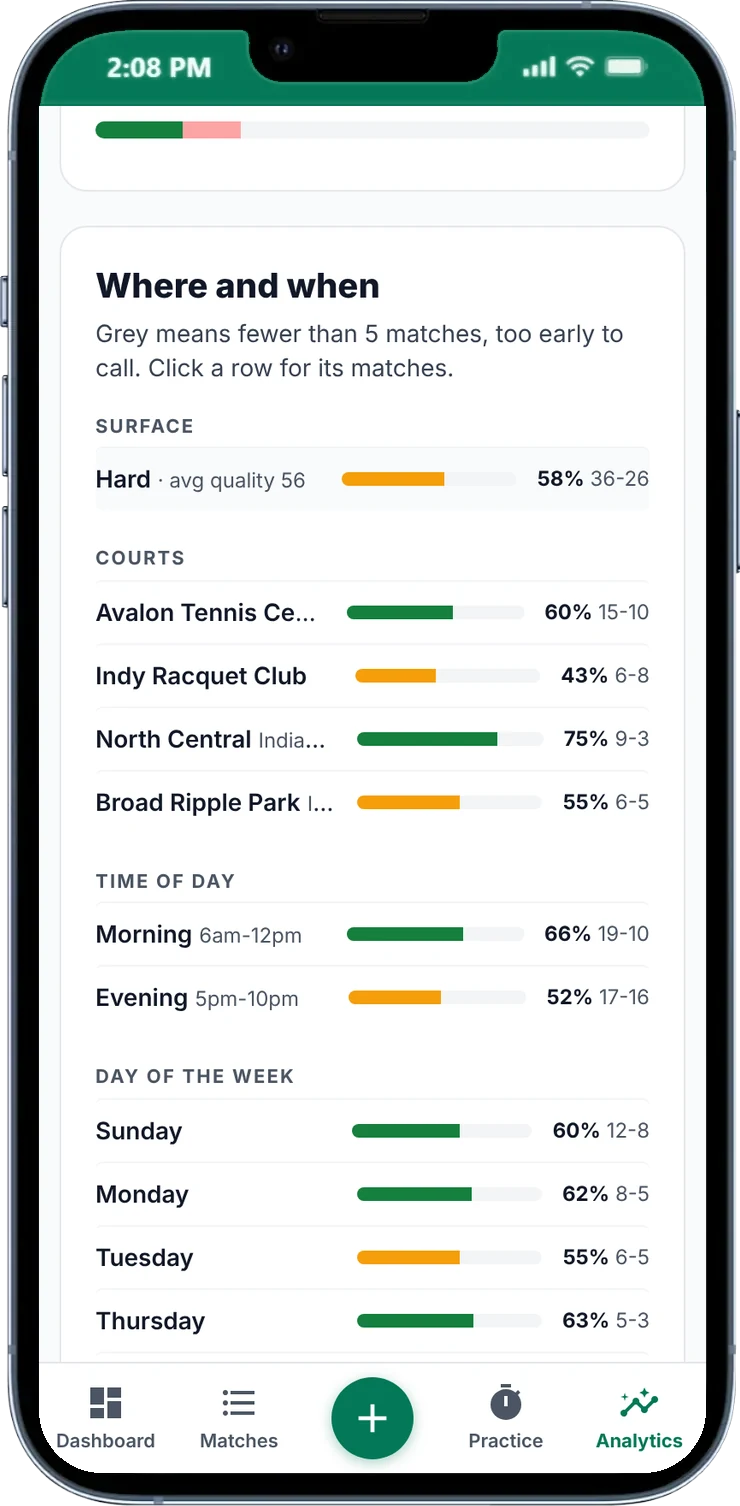
Find out where you play better.
Log your matches free and tag each court indoor or outdoor. Once you have a few of each, RecAce puts the two win rates side by side (with Pro, which you can try free for 30 days after 5 matches).
See My Indoor and Outdoor SplitWhat to Do With What You Find
The data is only useful if it changes a decision. A few decisions it should help with:
Where to play your important matches. If you have a USTA team and a choice between an indoor and an outdoor home venue, your data should weigh in. A team built around big servers and aggressive baseliners will likely do better indoors. A team that wins through consistency and retrieving might prefer outdoor home matches. The first USTA league season guide walks through these venue choices in more detail.
Which tournaments to enter. Most pickleball and tennis tournaments specify indoor or outdoor in advance. If your indoor record is significantly worse than your outdoor record, an indoor tournament is going to give you a tougher day. Knowing that in advance changes how you prepare and what your goals should be.
Where to practice. If you only play indoors and have a key match coming up outdoors (or vice versa), schedule at least three or four practice matches in the upcoming environment. The transition cost is bigger than most players assume.
What to work on. A consistent gap might point at a fixable weakness. Players who lose indoor matches often have a serve toss that drifts and needs simplification, or a return position that gives them too little time on a faster court. Players who lose outdoor matches often need a stronger high-ball backhand or better lob recognition. The gap itself is a clue.
The Trap of Trusting Memory
A common pattern: a player insists they "always play better indoors" or "can't stand outdoor tennis." When they pull up their actual win rates, the gap is either tiny or in the opposite direction.
Memory weights vivid matches disproportionately. One windy outdoor disaster sticks in the mind for years. One smooth indoor night under perfect lights does the same. The averaging that produces a win rate happens silently, and the brain does not do it well.
This is the same effect that makes tracking your tennis match record so much more useful than asking yourself how you have been playing lately. You do not really know until you look. The indoor versus outdoor split is one of the cleaner examples of the gap between perception and reality, because the environments feel so different that any pattern feels obvious. Often it is wrong.
A Quick Self-Audit
If you already have a year or two of match data, spend ten minutes on this:
- Pull up your overall win rate.
- Filter to indoor matches only. Note the win rate and the count.
- Filter to outdoor matches only. Note the win rate and the count.
- If you have at least 15 to 20 matches in each bucket, compare the two numbers.
- If the gap is more than five percentage points, dig into surface and opponent difficulty to see whether they explain it.
The gap might surprise you. The explanation might surprise you more. Either way, you will end up with a sharper picture of where your game actually lives, and a few decisions you can make better the next time you have a choice between two venues.
Start logging your matches in RecAce and the indoor versus outdoor split will surface itself.