


You are up 5-2 in the set, serving for it, and you have not lost your serve all afternoon. Then the next game goes to deuce. Then you drop it. Then it is 5-4, then 5-5, and the lead you spent forty minutes building is gone in ten. If that sequence feels familiar, you already know that learning how to close out a tennis match is a separate skill from getting ahead in one.
Most recreational players treat the lead as the hard part. It is not. Plenty of players can build a 5-2 advantage against an evenly matched opponent. Far fewer can serve it out without the wheels coming off. The gap between those two groups is rarely about strokes. It is about what happens to your decision making when the finish line is in sight.
This post covers why closing out matches is so hard, the specific patterns that cause leads to evaporate, and how to use your match history to find out whether closing is actually your weak spot or just the part you happen to remember.
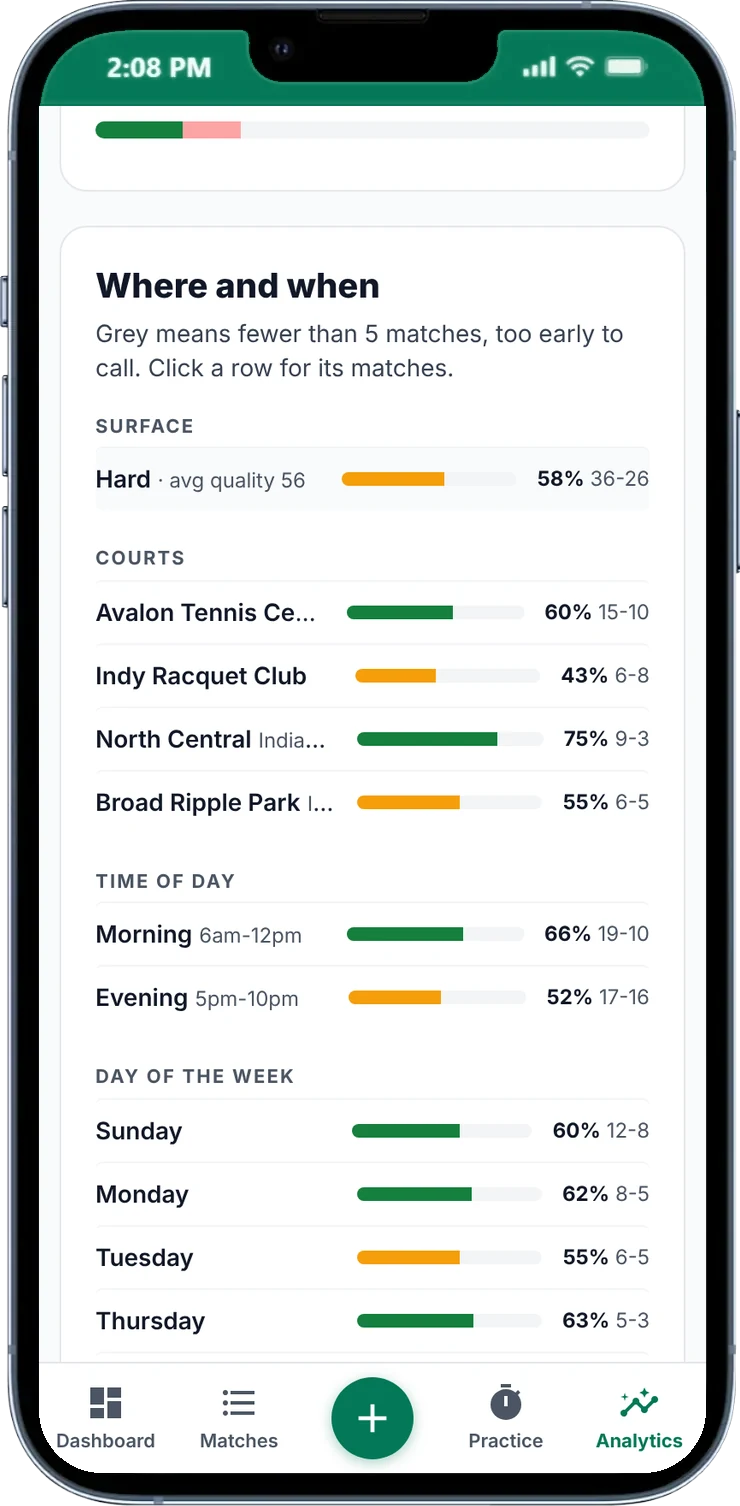
RecAce logs every set score, so you can see how often you win after leading versus how often you get pulled back. Once you have 20 or 30 logged sets, your closing rate stops being a feeling and becomes a number you can work on. Start tracking free.
Why Closing Out a Match Is Its Own Skill
When you are behind, you play loose. There is nothing to protect, so you swing freely, go for lines, and let instinct take over. When you move ahead, the math in your head flips. Suddenly there is something to lose, and the brain that was playing freely starts playing carefully.
Careful tennis is worse tennis for almost everyone. You shorten your swing, you stop moving your feet, and you start pushing the ball back instead of hitting through it. The opponent, who now has nothing to lose, starts doing exactly what you were doing five minutes ago. The momentum does not shift because of some mystical force. It shifts because the two players quietly trade styles.
That is the core problem. Closing requires you to keep playing the way that built the lead, at the exact moment your nerves are telling you to do the opposite.
The Three Ways Leads Disappear
When you look at your own data, blown leads almost always trace back to one of three patterns. Knowing which one is yours is most of the fix.
Pattern 1: The Safety Spiral
You get ahead, you decide to "just get the ball in," and your unforced error count climbs anyway. This is the most common pattern at the recreational level. The irony is brutal: playing safe produces more errors, not fewer, because a tentative swing has no margin and no depth.
The tell in your data is a set that was comfortable until a specific game, then turned into a string of tight scores. If your notes mention "got passive" or "stopped going for it" more than once across a season, this is your pattern.
Pattern 2: The Opponent Adjustment
Sometimes the lead does not vanish because you got worse. It vanishes because the opponent finally solved you. They figured out that your second serve sits up, or that your backhand breaks down under pace, and they started attacking it once they had nothing to lose.
This one is harder to see in the moment but easy to spot afterward if you keep opponent scouting notes. When the same opponent claws back leads on you repeatedly, the problem is not nerves. It is a pattern they have learned and you have not patched.
Pattern 3: The Pressure Cliff
You play fine right up until the score gets close, then your error rate spikes at 30-30, deuce, and break point. This is the same mechanism that shows up in tiebreak performance, and it tends to travel with a player across both situations. If you struggle to serve out sets, you usually struggle in tiebreaks too, because both are pressure-point problems wearing different clothes.
How to Find Your Real Closing Rate
The reason most players think they are bad at closing is that blown leads are unforgettable and routine holds are not. You remember the 5-2 that became 5-7. You do not remember the dozen times you served it out cleanly. Memory is a terrible scorekeeper, which is why tracking your match record matters more here than almost anywhere else.
Here is a simple way to pull the real number out of your data:
- Log the set score for every match, not just the final result. A 6-4 set and a 7-5 set carry very different information about how the close moments went.
- Add a one-line note when you led and lost the set, or led and held on. Something as short as "served it out clean" or "lost a 4-1 lead" is enough.
- After 20 to 30 sets, review the notes together. If three quarters of your tight sets include a phrase about going passive, you have your answer. If they mention a specific opponent or a specific shot, you have a different answer.
The point is not to obsess over one bad afternoon. It is to see whether closing is a genuine, repeating leak or a couple of memorable losses doing all the emotional work. Our guide to analyzing your tennis game without a coach walks through this kind of self-review in more detail.
Five Adjustments That Hold a Lead
Once you know closing is a real problem and which pattern is yours, these adjustments tend to move the number the most.
Keep the Pattern That Built the Lead
The single most useful rule: when you get ahead, do not change anything. If big first serves and aggressive returns got you to 5-2, those are exactly the shots that finish it. The instinct to "protect" the lead by dialing back is the instinct that loses it. Write this on your strings if you have to.
Play to a Target, Not to a Score
When the score gets tight, stop thinking about the score. Think about where the ball is going. Pick a serve location and a first-strike target before each point and commit to it. This is the same pre-deciding approach that works in tiebreaks, and it works for the same reason: it replaces the question "what if I lose this point" with a concrete physical task.
Reset Between Points
Most leads collapse over two or three rushed games. The antidote is a deliberate between-point routine: turn to the back fence, take a breath, adjust the strings, then walk to the line with a plan. Slowing your own pace down is the cheapest way to break an opponent's momentum.
Serve to the Body Under Pressure
When nerves shrink your swing, your serve placement gets less reliable. A body serve has the most margin of any target because it does not require you to thread a corner. On the biggest points of a closing game, a serve aimed at the returner's hip is often the highest-percentage play available.
Accept That the Opponent Will Raise Their Level
The player chasing the set is supposed to play better. That is normal, not a disaster. If you expect a pushback at 5-2 instead of being surprised by it, you are far less likely to panic when it arrives. Plan for one rough game, weather it, and serve out the next one.
Practice the Finish, Not Just the Start
Almost every practice set begins at 0-0 and ends before anyone has to serve out anything meaningful. So most players get thousands of reps at starting a set and almost none at finishing one. That imbalance is the whole problem.
Fix it directly. In your next hitting session, start practice games at 4-2 and play them out, alternating who holds the lead. Then start a set at 5-4 and make the leader serve it out. The first few times will feel awkward because the situation is unfamiliar, which is exactly the point. Make the finish familiar and it stops feeling like a cliff.
This is the same idea behind tracking pressure situations across sports. A pickleball player working on the same nerves can drill the kitchen exchanges that decide tight games; a tennis player drills serving out sets. The skill, staying aggressive when the finish is close, transfers in both directions.
What the Data Shows Over a Season
When you have logged a full season of sets with closing notes, the picture clears up fast.
You will see your real closing rate as a percentage, not a memory. You will see whether the blown leads cluster against specific opponents (an adjustment problem) or appear against everyone (a nerves problem). You will see whether the gap is shrinking as you practice the finish, which is the kind of honest year-over-year progress that feel-based self-assessment never gives you.
Players who track this tend to fix it faster, because they stop treating every blown lead as a character flaw and start treating it as a measurable, trainable pattern. The 5-2 lead that used to feel like a trap becomes a lead you expect to convert, because you have the reps and the data to back it up.
Convert the Next One
You probably have a match this week where you will get ahead at some point. The question is whether you serve it out or hand it back. Start by logging your set scores and a one-line note whenever you lead, then pull up the pattern after a month and pick the one adjustment above that fits.
Create your free RecAce account and track your next set. Getting ahead is the part you already know how to do. Closing it out is the skill that wins the matches you are supposed to win.