


You're 60% on hard courts and 35% on clay. You just don't know it yet.
Most recreational tennis and pickleball players have a surface they dominate on and a surface that quietly destroys their record. But without data, surface performance lives in the realm of feelings, "I think I play better outdoors" or "clay doesn't suit my game." Feelings are unreliable. Numbers aren't.
RecAce Pro tracks your win rate across every court surface and venue you play on. This data reveals patterns that change how you practice, where you compete, and which matches you approach differently.
Your surface breakdown is one of the five stats every recreational player should track. RecAce calculates it automatically from the surface details you log with each match.
Why Surface Performance Matters More Than You Think
Tennis and pickleball are not the same sport on different surfaces. The ball bounces differently. The speed of play changes. Your footwork demands shift. Your strengths and weaknesses get amplified or muted depending on what's under your feet.
Consider these real patterns:
- Hard courts favor aggressive baseliners and big servers. The consistent, medium-paced bounce rewards power and precision.
- Clay courts slow the ball down and give defenders time to retrieve. Patient counterpunchers thrive here.
- Grass courts speed up the game and produce low, skidding bounces. Net rushers and serve-and-volley players gain an edge.
- Indoor courts remove wind and weather variables. Players with technical precision often see their best numbers indoors.
In pickleball, surface matters too. Outdoor courts with textured concrete play faster than smooth indoor surfaces. Wind on outdoor courts changes dink exchanges entirely. Temperature affects ball bounce on every surface.
The question isn't whether surface affects your game. It's how much, and RecAce gives you the exact answer.
What RecAce's Surface Analytics Show You
Win Rate by Surface
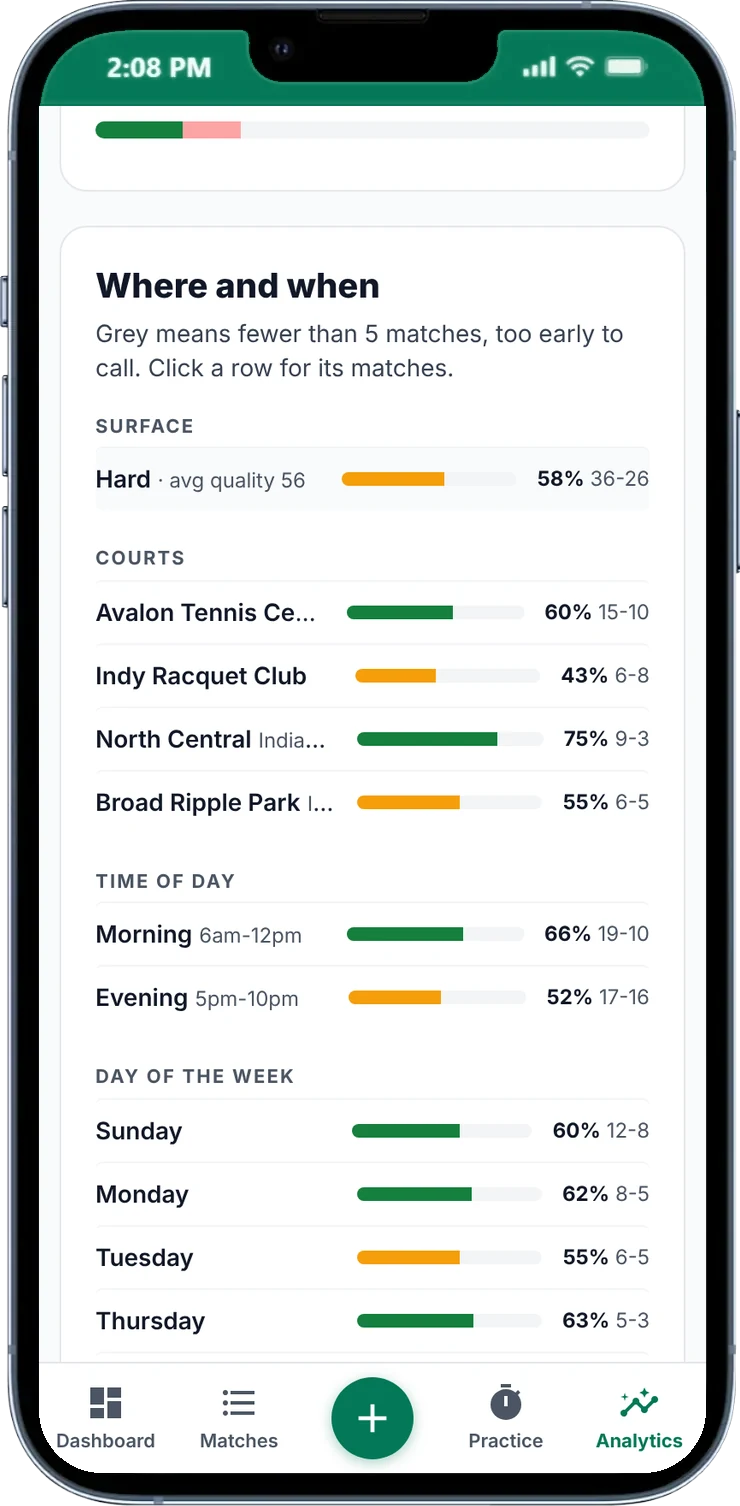
RecAce Pro's Where and when card breaks down your record on every surface you've played on. Each surface shows:
- Total matches played on that surface
- Win rate as a percentage, once the surface has 5 matches (fewer reads "Too early")
- Wins and losses as raw numbers
This is where surprises happen. Players regularly discover:
- They're 15-20% better on one surface than another
- A surface they "don't like" actually produces average results, the discomfort is emotional, not statistical
- A surface they feel neutral about is quietly their worst performer
Win Rate by Location
Beyond surface type, the same Pro card shows your record at each court you've played at. This reveals:
- Home court advantage: most players perform measurably better at familiar venues
- Venue-specific patterns: maybe the lighting at one court bothers you, or the surface at your rival's club plays faster than yours
- Travel impact: how your game holds up at away venues versus home
Home court advantage is real and measurable in recreational play. If you're 70% at your home courts and 45% everywhere else, that's not noise. That's a pattern worth understanding.
Time-of-Day and Day-of-Week Splits
RecAce Pro also breaks down your performance by when you play:
- Morning / Afternoon / Evening performance splits
- Day-of-week win rates, you might be a weekend warrior who underperforms on weekday evenings
These time-based patterns interact with surface. Maybe you're great on outdoor hard courts in the morning but struggle on the same surface under lights at night. That's actionable information.
How to Use Surface Data Strategically
1. Play to Your Strengths When It Counts
If you're entering a tournament or a high-stakes league match, choose the surface where your data shows the strongest performance, if you have the option. This sounds obvious, but most players make this choice based on convenience or habit rather than data.
If RecAce shows you're 68% on hard courts and 42% on clay, and your next competitive match lets you choose the venue, the data has made the decision for you.
2. Identify Why Certain Surfaces Hurt Your Game
When you spot a surface weakness, dig into why. Check your H2H records against specific opponents on that surface. Review your scouting notes for matches played there. Look for patterns:
- Are you losing to everyone on clay, or just a few specific opponents who happen to play there?
- Does your loss pattern correlate with match length? Clay matches tend to be longer, maybe fitness is the real issue.
- Are your losses clustered at specific venues? It might be the venue, not the surface.
3. Train on Your Weak Surface
Once you've identified a surface weakness, practice there intentionally. If you're 35% on clay, booking weekly clay court sessions will develop the specific skills you need: footwork, patience, point construction, sliding movement.
Log these practice matches in RecAce as Casual matches and watch your clay court percentage climb over the weeks.
4. Factor Surface Into Opponent Scouting
When preparing for a match, combine your surface data with your opponent scouting profile. RecAce's H2H records include surface breakdowns for each opponent:
- You're 5-1 against Mike on hard courts but 1-4 on clay
- Your RecAce odds against Sarah (Pro) are low overall, but your record against her on fast surfaces is much better
- Your notes say "struggles with low, fast bounces", schedule the match on a hard court
This is opponent scouting elevated by surface intelligence. Neither piece alone is as powerful as the combination.
5. Plan Your Season Around Surfaces
If you track matches consistently, your year-over-year data will reveal seasonal surface patterns. Outdoor clay season runs May through September in most regions. Indoor hard court season fills the winter months. Grass is a short window in summer.
Understanding how your performance shifts across these seasonal-surface cycles helps you:
- Set realistic goals for each period, don't expect personal-best win rates during your weak-surface season
- Front-load practice before a surface transition, hit the clay courts in April before league play starts in May
- Evaluate progress accurately: a dip during clay season isn't a slump if your clay numbers are actually improving year over year
RecAce's Patterns in your numbers include a "Best surface" pattern that names the surface where you win most. No manual analysis needed, RecAce counts it from your results.
Surface Analysis for Pickleball Players
Pickleball surface analysis follows similar principles but with sport-specific nuances:
- Indoor vs. outdoor is often the biggest split in pickleball. Outdoor wind changes the game fundamentally, especially in the kitchen.
- Surface texture matters more in pickleball than surface material. Smooth indoor gymnasium floors play very differently from textured outdoor concrete.
- Temperature effects are significant, pickleball balls play faster in heat and slower in cold weather. If your win rate drops every winter, it might be the ball, not you.
RecAce tracks all of this the same way it tracks tennis surfaces. Log the surface type and location with each match, and the analytics build automatically.
The Surface Data Most Players Miss
There's a subtlety that separates good surface analysis from great surface analysis: sample size context.
If you're 90% on grass but you've only played 3 matches there, that number doesn't mean much. If you're 55% on hard courts across 80 matches, that's a reliable indicator. RecAce shows match counts alongside win rates so you can judge confidence levels.
As a rule of thumb:
- Under 10 matches: Interesting but not reliable. Keep logging.
- 10-25 matches: Patterns emerging. Worth noting but not restructuring your schedule around.
- 25+ matches: Reliable. Use this data with confidence for strategic decisions.
This is where consistent match tracking compounds. Every match you log on a given surface strengthens your dataset and makes your surface analytics more trustworthy.
Putting It All Together
Surface data doesn't exist in isolation. It connects to everything else in your RecAce analytics:
- Your rating reflects overall skill, but your surface-specific performance tells you where that skill peaks and dips
- Your H2H records become far more interesting when filtered by surface, a 5-5 all-time record might be 5-1 on hard and 0-4 on clay
- Your Patterns in your numbers best surface and best court feed directly from this data
- Your opponent scouting notes gain context when you know which surface those observations came from
- Your doubles partnership data may vary by surface, some partnerships work better on specific courts
Start logging surface details with every match. RecAce makes it easy, one tap during the match entry form. Within a month, you'll have enough data to see your first surface patterns. Within a season, you'll have a complete surface profile that informs every strategic decision you make.
Start using RecAce's free match stat tracker and log your surface details. Your court data is waiting to reveal what you can't see by feel alone.