


The phrase "home court advantage" gets thrown around in every sport, but most recreational tennis and pickleball players have no idea whether it is real for them. They have a hunch. They feel like they win more at their home club. They feel like the indoor courts at the rec center are easier than the outdoor ones at the park. None of that is data.
If you log your matches with the venue attached, the question stops being a hunch. After 50 or 60 matches across two or three regular venues, your win rate by location is a number, and that number tells you something useful. It might confirm what you suspected. It might surprise you. Either way, you can plan around it.
This post covers what venue actually means in a tennis and pickleball context, why home court advantage exists, how to read your own venue stats without fooling yourself, and how to use the data to schedule and prepare for matches that matter.
Surface and venue are different things. Surface is the playing material (hard, clay, grass, indoor pickleball, outdoor pickleball). Venue is the specific location. Two hard courts at two different clubs can feel completely different to play on. Track both.
What "Venue" Actually Captures
Venue is the specific physical location where you played the match. Your home club, the public park down the road, the indoor facility you visit twice a month, the tournament site you only see once a year. The venue field is finer-grained than the surface field, and that finer grain is where the interesting patterns live.
Two hard courts can play very differently because of:
- Court speed. Some hard courts are sanded heavily and play slow. Others are slick and play fast.
- Lighting. Indoor lighting varies dramatically. Some facilities have shadows that affect tracking the ball. Outdoor venues at certain times of day put the sun directly behind the server.
- Background contrast. A court with a dark green wall behind the baseline plays differently than one with a glass wall and a parking lot behind it. Tracking the ball is harder against busy backgrounds.
- Net height and tension. Older recreational nets sag. Tournament-spec nets are tight to the regulation height. The few inches matter.
- Ball type used. Most clubs default to specific ball brands. Two clubs that "use the same ball" often actually use slightly different versions of it.
- Wind, in outdoor venues. A venue in an open field plays nothing like a venue surrounded by buildings.
- Altitude, in some regions. Higher altitude makes balls fly faster and bounce higher.
These variables stack. Two outdoor hard courts in the same city, both technically the same surface, can produce noticeably different match outcomes. That is what venue tracking captures and what surface tracking misses. Our breakdown of surface and court data covers the broader surface question; this post is specifically about why two venues with the same surface can still produce different results.
Why Home Court Advantage Exists
Home court advantage in recreational tennis and pickleball is not the same as in professional sports. There is no crowd. There are no referees. There is no travel fatigue from a flight the night before. The effect is more subtle, and it comes from a few specific sources.
Familiarity with the playing conditions. You know the speed of the court. You know which baselines are slick. You know how the wind cuts across in the afternoon. You know the depth perception against the back fence. Every one of these is worth a few free points per match.
Familiarity with the equipment. You know how the club's balls play after they have been opened a couple of days. You know whether the courts get watered before evening league nights. You know which courts have the worst lighting and avoid them when given a choice.
Comfort routines. Your warmup is dialed in because it always happens in the same locker room, with the same cup of water, with the same five minutes of dynamic stretching. Anything that disrupts the routine costs a small amount of focus.
Travel and arrival state. Even a 15-minute drive to a new venue means you arrive less settled. You are scanning for the right courts, finding parking, navigating an unfamiliar layout. The first game often goes by before you are fully present.
For most recreational players, the size of the effect is somewhere between 5 and 15 percentage points of win rate. That sounds small until you realize that for a 50% player, a 10-point home advantage means they are nearly a 60% player at home and a 40% player away. That is the difference between winning a league season and finishing mid-pack. We dig into the win rate question in a separate post if you want context on what a 10-point swing actually means.
How to Read Your Own Venue Stats
The biggest mistake is reading the data after too small a sample. A 12-3 record at your home club and a 4-7 record at a rival club looks like a clear home advantage, but those are 15 and 11 matches respectively. Random variance can produce that gap from nothing.
Roughly:
- Under 20 matches at a venue: treat the stats as suggestive, not conclusive.
- 20 to 50 matches: patterns start to be real, but adjacent factors (opponent strength, time of year) need accounting.
- 50+ matches: the win rate is a meaningful estimate of your actual performance there.
Three checks before you trust a venue gap:
Check opponent strength. If you only play your weaker friends at home and your stronger friends at the away club, your home advantage might just be the matchup, not the location. Most match trackers let you filter by opponent or by opponent rating; do that filter before drawing conclusions.
Check format. If your home court is where you play singles and the away court is where you play doubles, the venue gap might really be a format gap. Singles and doubles are different games. We cover this in why you should track both formats separately.
Check time of day. If your home matches are mostly weekend mornings and your away matches are mostly weekday evenings, time of day is the confounder. Our post on morning versus evening tennis covers how big this effect can be.
Once you have controlled for those three, the residual difference is your real venue effect.
What to Do With a Real Home Court Advantage
If your data shows a clear home edge (let's say 12 percentage points after 60+ matches), there are practical moves to make.
Schedule competitive matches at home when possible. League captains often have flexibility on where to play home matches. Tournament directors do not. But for friendly matches, partner challenges, and rec league bookings, leaning toward your strong venue is a free improvement.
Get to away venues earlier. A 20-minute warmup at an unfamiliar court closes most of the comfort gap. Arriving five minutes before match time leaves the gap wide open. Arriving 30 minutes early lets you hit on the actual court you will play on, feel the speed, and adjust.
Practice at the away venue when you can. If a key away match is coming up at a specific club, finding even one practice session there in the week before is high-leverage. Your nerves and unfamiliarity drop sharply once the courts feel known.
Track what specifically changes when you travel. This is where match notes earn their keep. After an away match, write a one-line note: "courts faster than home," "lights felt low," "ball played heavier than I am used to." Over a season, the patterns surface. The third time you play that venue, your prep is informed by data, not memory.
For more on note-taking and the journaling workflow, see how to keep a tennis and pickleball match journal.
What to Do With a Negative Home Effect
Less common but not rare: some players actually win more away than at home. The data shows it, and the player is surprised.
Why this happens:
The home opponent pool is harder. If your home club has stronger players and you mostly play down at the away club, the away win rate is inflated by easier opponents.
Home distractions. A home club where you also socialize, take lessons, and run into people you know between points can pull focus away from the match. Some players play sharper at quieter venues because the focus is forced.
Bad-court habit. If your home club has one or two specific courts you always end up on, and those courts have quirks (low fence, sun exposure, slope), your home advantage is being eroded by infrastructure.
The fix in all three cases is the same: identify the confounder, account for it where you can, and either change the venue conditions or change your matchups.
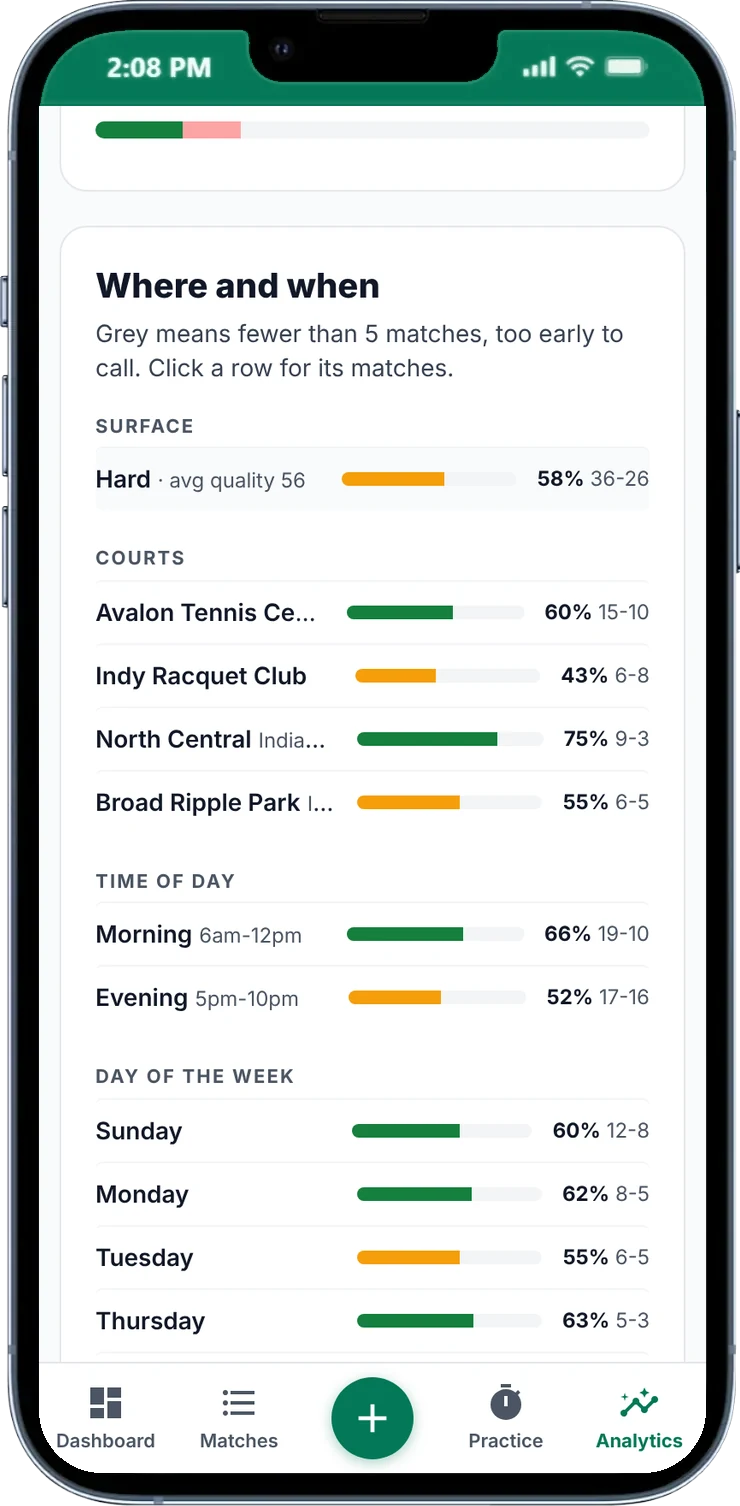
A Sample Read on Three Venues
Imagine a typical recreational player after 80 matches:
| Venue | Matches | Win Rate | Avg Opponent Rating |
|---|---|---|---|
| Home club (outdoor hard) | 38 | 61% | 3.7 |
| Public park (outdoor hard) | 24 | 54% | 3.5 |
| Indoor facility (cushioned hard) | 18 | 39% | 3.6 |
A few things are visible.
The home win rate is 7 points above the public park, but the home opponents are stronger on average. Once you adjust for opponent rating, the venue advantage is closer to 12 to 15 points. Real home court effect.
The indoor venue win rate is much lower than the other two, with similar opponent quality. The drop is too big to be random. Something specific about indoor play is hurting this player. Maybe lighting, maybe ball type, maybe court speed. The next move is a few notes from indoor matches to find the culprit.
This is the kind of read that becomes possible after 50+ matches with venue data attached. Without venue tracking, you have a vague sense that "I do better outside." With the data, you have a measurable gap and a specific question to investigate.
For the broader set of stats worth tracking, see five stats every recreational tennis player should track. The post on opponent scouting covers how to combine venue notes with per-opponent data so you arrive at every match prepared.
Venue Tracking Pays Off Slowly
The frustrating thing about venue stats is that the data takes a while to be useful. After 10 matches, you have noise. After 30, you have a hint. After 60 to 80, you have a real picture. Most players quit before they get there.
The fix is automation. If your match log captures venue automatically as a dropdown rather than a free-text field, the cost of tagging is one tap per match. Over a season, that adds up to no extra effort and a complete venue history. Without it, players type "Riverside Tennis Club" three different ways across a season and the analytics break.
Log your matches free at RecAce and tag the venue every time. After your next 50 matches, your venue dashboard will tell you exactly where you play your best tennis or pickleball, where you struggle, and which conditions deserve a closer look. Home court advantage stops being a feeling and starts being a number.