


Ask ten players at open play what their DUPR rating means and you will get ten different answers, most of them wrong in some small way. DUPR has become the default rating system in competitive pickleball, tournaments seed by it, ladder leagues sort by it, and players obsess over the third decimal place, yet the mechanics behind the number stay murky for most of the people carrying one.
This guide explains how a DUPR rating actually gets calculated, what the numbers mean on court, why your rating sometimes drops after a win, and what to do about the large share of your pickleball life that DUPR never sees.
DUPR rates every player on the same scale, roughly 2.0 to 8.0, using match results and score margins rather than self-assessment. It is the closest thing pickleball has to a universal number, but it only counts matches that get posted to the system. Your rec games, club nights, and casual battles stay invisible unless you track them yourself.
How DUPR Works
DUPR stands for Dynamic Universal Pickleball Rating. Three design choices define it.
One scale for everyone. Juniors, senior pros, and Tuesday-night rec players all live on the same 2.0 to 8.0 continuum. A 4.5 means the same thing in Florida as it does in Oregon, which is exactly what the older self-rating culture could never deliver.
Results plus margins. DUPR looks at who won, who they beat, and how close the game was. Beating a stronger opponent moves your rating up more than beating a weaker one, and an 11-9 loss to a better player costs you far less than an 11-2 blowout. If you have read our breakdown of how ELO ratings work, the logic will feel familiar: DUPR is an expectation model. Beat the expectation and you rise, fall short of it and you drop.
Separate singles and doubles ratings. Your doubles DUPR and singles DUPR are calculated independently, because they are genuinely different games. A 4.2 doubles player might be a 3.7 in singles, and the system respects that instead of averaging it away.
Matches enter the system from DUPR-sanctioned tournaments and leagues, from clubs that report results, and from self-posted scores that opponents can validate. Recent matches count more than old ones, so the rating tracks your current form rather than your career average.
The Reliability Piece
Alongside the rating itself, DUPR tracks how much data sits behind it. A rating built on six matches and a rating built on sixty can show the same number while deserving very different levels of trust. Until you have a meaningful match history in the system, treat your DUPR as a rough sketch. This is the same reason we tell new players to focus on volume across their first 100 games: no rating system, DUPR included, can outrun a small sample.
What the Numbers Mean
DUPR does not publish official skill descriptions per band, but in practice the tiers map closely to the traditional levels players already use. For the full skill-by-skill breakdown of each tier, see our pickleball skill levels guide. The short version:
| DUPR Range | What It Looks Like on Court |
|---|---|
| Under 3.0 | Learning the rules, developing serves and returns |
| 3.0 – 3.5 | Sustains short rallies, starting to use the soft game |
| 3.5 – 4.0 | Reliable third shots, understands kitchen positioning |
| 4.0 – 4.5 | Consistent dinking, intentional speed-ups, few free points |
| 4.5 – 5.0 | Strong tournament player, controls tempo and transitions |
| 5.0+ | Top amateur to professional level |
The center of gravity at most clubs sits between 3.0 and 4.0. If your number lands there, you are in the thickest, most competitive part of the curve, where a tenth of a point genuinely separates players.
DUPR only counts the games you upload.
RecAce tracks every rec game, ladder night, and league match you log and builds a live rating from all of it. Free, and it keeps tennis in the same account.
Track My Pickleball Rating FreeWhy Your DUPR Moves in Strange Ways
The most common DUPR complaints all trace back to the same handful of mechanics.
You won and your rating dropped anyway. The algorithm expected you to win by more. An 11-9 grind against a much lower-rated team can land below expectation even though you took the game. Margin matters, so closing games out strongly protects your rating as much as your pride.
Your partner shapes your doubles rating. In doubles, the system evaluates the team result against both teams' combined ratings. Carry a weaker partner to a narrow win and the math may treat it as underperformance. This is one more reason partner data is worth tracking: your results genuinely differ by pairing, and so does what the algorithm expects of you.
Unrated or barely-rated opponents add noise. When the system knows little about the other side of the net, it has to guess, and your rating absorbs some of that guesswork. Results against established, frequently-rated players move your number more predictably.
Format changes the texture of results. An 11-point rally-scoring game and a traditional side-out game produce different score margins for the same skill gap. If your league switches formats mid-season, expect some turbulence. Our explainer on rally scoring versus side-out covers how the two systems change scoreline math.
None of this makes DUPR broken. It makes DUPR a statistical model, and statistical models wobble on small samples and odd inputs. The fix is more data, not less trust.
How to Raise Your DUPR
Players chasing a number sometimes try to game it, ducking strong opponents or hunting blowouts against weak ones. That works poorly and reads worse. The moves that actually raise a DUPR are the same ones that make you better:
- Play rated matches often. A rating fed twice a month tracks your improvement. A rating fed twice a year lags it badly.
- Compete for every point, especially when losing. Turning an 11-3 loss into 11-8 protects your rating and builds the habit of problem-solving mid-game.
- Play up when you can. Close losses to stronger players cost little and teach a lot. A steady diet of much weaker opponents caps your ceiling because even dominant wins barely move the model.
- Prepare like results matter. Scouting opponents, knowing your patterns, and picking the right partner all show up in margins. Our guide to tournament prep with match data walks through that process.
Then give it time. Ratings follow skill with a delay, and the players who improve fastest are usually watching their game, not their decimal.
The Matches DUPR Never Sees
Here is the structural gap. DUPR only rates what gets posted, and for most recreational players that means tournaments, sanctioned leagues, and the occasional club event. The Thursday round robin, the standing 8 a.m. games, the grudge matches against your regular rivals, all of it vanishes. For a typical rec player that invisible share is most of their pickleball.
RecAce covers that side of your game. Log every match you play, rated or not, and you get a transparent ELO rating that updates instantly, plus the layer DUPR never offers: your record with each partner, head-to-head records against every rival, streaks, and scouting notes.
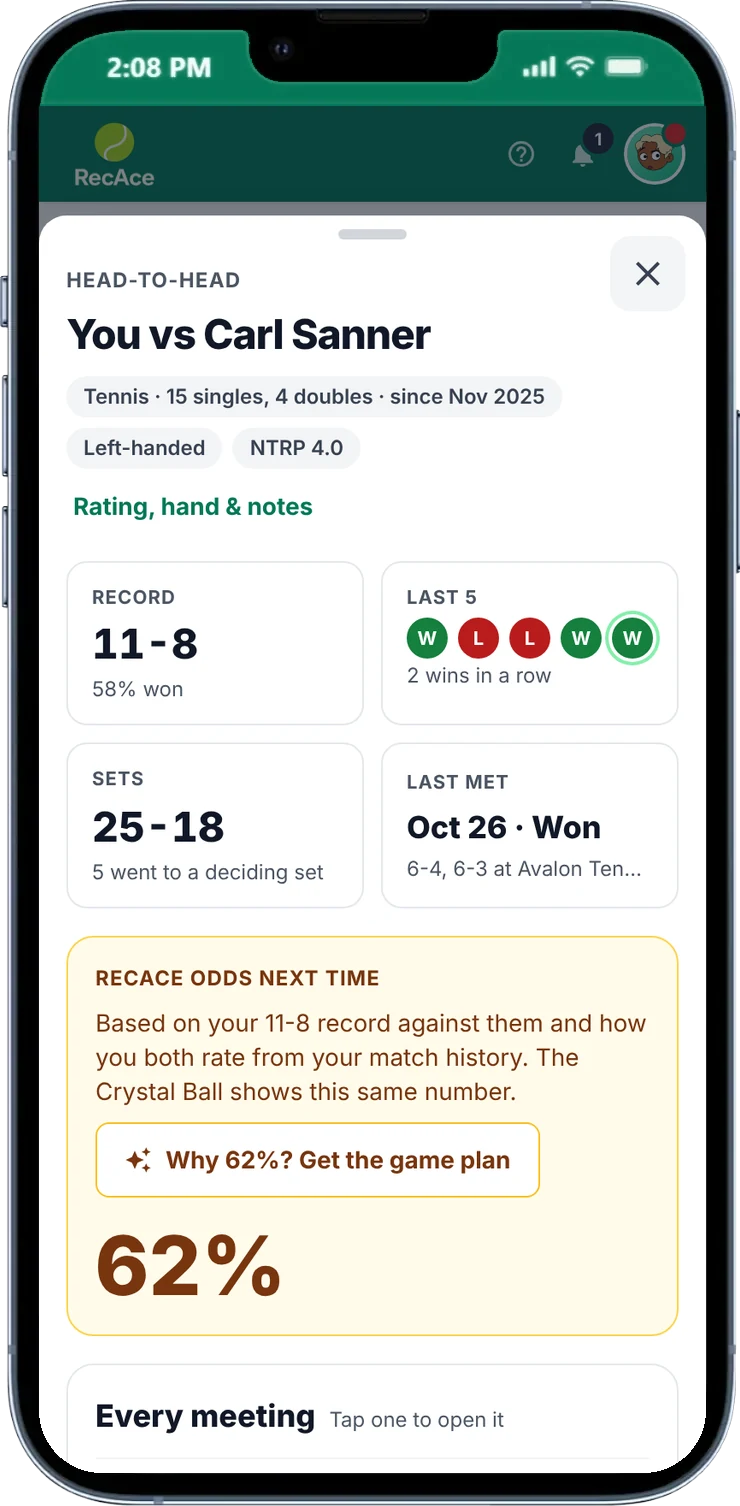
The two systems answer different questions. DUPR tells you where you stand in the wider competitive pool. Your own match history tells you why: which partners lift you, which opponents have your number, whether your soft game holds up in long grinds. Tennis players learned this lesson with their own rating scales, and the parallel runs deep, our UTR to NTRP conversion chart tells the same story of official ratings that miss most of a player's real matches.
Quick Answers
Is DUPR free? Yes, a player profile and rating are free. Tournaments and leagues that feed it may have their own entry costs.
What DUPR should I list at open play? List the number, but say the sample too. "4.1 doubles, about 40 rated matches" is a far more honest label than the number alone.
Do rec games count toward DUPR? Only if someone posts them to the system and they pass validation. Most casual play never gets posted, which is exactly the gap self-tracking closes.
Can I have different singles and doubles DUPRs? Yes, and most players do. Track both formats separately in your own data too, because the skills barely overlap.
Own Both Numbers
Your DUPR is the rating the pickleball world sees. Your match history is the rating you can actually act on. Carry both.
Create a free RecAce account, log your matches from open play to tournament day, and watch your real level take shape alongside the official one.